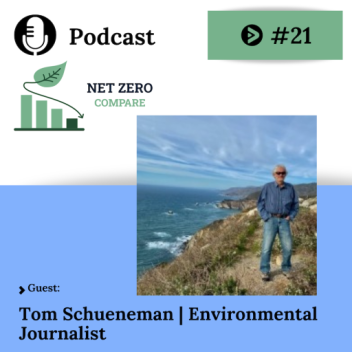
#21: Tom Schueneman on From Doom to Dialogue: How Climate Communication Can Reconnect People With Reality
In this episode
Executive summary
In this conversation, environmental journalist Tom Schueneman argues that the main barrier to climate action is not lack of information, but ineffective communication. While public awareness of climate change has increased and outright denial has declined, many people feel overwhelmed, fatigued, or disconnected by alarmist and abstract messaging. Schueneman stresses that audiences increasingly want practical solutions and narratives that reflect everyday realities. He highlights the importance of storytelling over statistics, using shared values such as clean water, healthy ecosystems, and future generations to build connection and reduce polarization. The discussion also addresses systemic issues such as greenwashing, misplaced responsibility on consumers, and communication silos between science, business, and the public. Schueneman advocates for transparency, evidence-based sustainability claims, and balanced engagement to avoid burnout. He also highlights underexplored challenges, such as AI’s environmental footprint and its dependence on plastic, and calls for urgent reductions in emissions through scalable renewable energy sources. Ultimately, he concludes that clear, honest, and human-centered communication is essential to turning climate awareness into meaningful action.
Public awareness of climate change has grown steadily over the past two decades, but awareness alone has not translated into clarity or action. In many cases, it has produced the opposite: fatigue, polarization, and disengagement. According to Tom Schueneman, environmental journalist and founder of GlobalWarmingIsReal.com and PlanetWatch Group, the core problem is not a lack of information. It is how climate information is communicated.
During a recent conversation with Net Zero Compare, Schueneman shared insights drawn from nearly twenty years of reporting on climate science, environmental policy, and sustainability narratives. His experience offers a grounded perspective on why climate communication often fails and what can be done differently.
🎥 Watch our full interview with Tom Schueneman, environmental journalist and founder of GlobalWarmingIsReal.com and PlanetWatch Group, where he explores why climate communication often creates fatigue instead of action, how storytelling and shared values can reconnect people with reality, and why transparency, credibility, and human-centered narratives are essential to turning climate awareness into meaningful engagement.
Climate Awareness is Rising, but People Want Solutions
One of the most noticeable shifts Schueneman has observed is a gradual increase in public acceptance that climate change is real and human-driven. While misinformation still exists, he notes that overt hostility toward climate reporting has declined compared to the early years of his work. This change aligns with broader research, including long-running studies on public perception conducted by Yale University.
At the same time, audiences are increasingly impatient with abstract warnings and catastrophic framing. Readers and listeners are looking for solutions, or at least for pathways that feel tangible and human.
Many people are not immersed in climate topics daily. They are raising families, building careers, and managing everyday responsibilities. When climate communication ignores this reality, it risks alienating the very people it aims to inform.
Why Storytelling Matters More than Statistics
Schueneman emphasizes that data alone rarely changes minds. Metrics such as parts per million of CO₂ or sea-level rise projections are essential for scientific understanding, but they often fail to resonate emotionally. Effective climate storytelling starts by finding common ground.
He shared examples from conversations with people who might not initially identify as concerned about climate change, including hunters, anglers, and outdoor enthusiasts. Rather than framing the discussion around climate terminology, he focuses on shared values: healthy ecosystems, clean water, and the ability for future generations to enjoy the natural world.
This approach avoids ideological triggers and restores a sense of shared responsibility. It also counters one of the biggest risks in climate discourse: the breakdown of human connection.
Silos, Greenwashing, and Misplaced Responsibility
A recurring theme in Schueneman’s work is the “silo effect.” Scientists, policymakers, businesses, journalists, and the public often operate in parallel information streams, rarely translating insights across boundaries.
Scientists may produce rigorous research but lack the tools to communicate it effectively to non-technical audiences. Businesses, on the other hand, frequently frame sustainability efforts as marketing narratives rather than verifiable commitments. When sustainability messaging sounds more like public relations than accountability, trust erodes.
Schueneman also criticized the tendency to shift responsibility disproportionately onto consumers. Recycling campaigns, for example, can obscure the larger systemic issues of product design, excessive packaging, and linear economic models. While individual action matters, it cannot compensate for structural decisions made upstream.
True progress requires transparency. When companies claim emissions reductions or sustainability gains, those claims must be supported by evidence, not slogans.
Staying Engaged Without Burning Out
The sustainability information environment is crowded, noisy, and often overwhelming. Schueneman argues that staying informed does not mean constant consumption of climate news. In fact, stepping back is sometimes necessary.
He recommends balancing information intake with time spent reconnecting to the natural world. Going for a walk, observing ecosystems firsthand, and cultivating gratitude can help maintain perspective and resilience. This mindset supports long-term engagement rather than short-term anxiety.
In terms of content, he points readers toward well-researched journalism and carefully crafted storytelling. He also highlighted The Ministry for the Future by Kim Stanley Robinson as an example of fiction that successfully integrates climate science, economics, and policy into a compelling narrative without sacrificing depth.
Schueneman also applies these principles in his own audio work. He hosts the Earthbound podcast, where he explores climate, environmental, and sustainability topics through long-form conversations and reflective storytelling. Rather than chasing headlines, the podcast focuses on context, lived experience, and the human dimensions of environmental change, offering listeners space to engage with the issues without being overwhelmed.
Overlooked Sustainability Challenges: AI and Plastics
When asked which issues deserve more attention, Schueneman pointed to two areas that are often discussed in isolation from climate conversations.
The first is artificial intelligence. While AI tools can improve efficiency and research productivity, their environmental footprint is growing rapidly. Data centers require significant amounts of electricity and water, and they are often located in lower-income communities that bear the local impacts. These trade-offs are rarely included in mainstream AI narratives.
The second is plastic, particularly single-use plastic. Beyond pollution, plastic production and disposal carry climate implications tied to fossil fuel use. Schueneman contrasted today’s linear economy with earlier models of reuse and circularity, noting that practical examples of circular systems existed long before sustainability became a buzzword.
Nuclear Energy and the Urgency of Emissions Reduction
On nuclear power, Schueneman expressed a cautious and pragmatic stance. While modern nuclear technology may play a role in long-term decarbonization, it is not a near-term solution. Nuclear plants take many years to develop, and unresolved questions about waste management remain.
Given the urgency of reducing emissions now, he believes resources should prioritize technologies that can be deployed more quickly, such as wind, solar, geothermal, and other renewables. Nuclear may be part of the future mix, but it should not distract from immediate action.
Communication as the Real Lever of Change
For organizations trying to communicate sustainability credibly, Schueneman’s advice is straightforward. Avoid lecturing. Meet people where they are. Be honest about limitations as well as progress.
Internally, companies should treat environmental responsibility as a core operational issue, not a branding exercise. When employees understand and believe in that commitment, communication becomes more authentic externally as well.
Ultimately, the conversation kept returning to the same conclusion: communication is not a secondary concern in climate action. It is a determining factor. Without clear, respectful, and human-centered communication, even the best policies and technologies risk falling short.
More from Net Zero Compare Podcast
#24: Andri Johnston on Digital Sustainability in Publishing: Practical Lessons from Cambridge University Press & Assessment
#23: Lee Stewart on How Companies Can Turn ESG Commitments Into Real Progress: Insights from Lee Stewart
#22: Pini Reznik on Why AI Native Transformation Is About Structure, Not Tools
#20: Mike Gifford on Digital Sustainability Starts with How We Build the Web
.png)
#19: Nina Benoit (Brightest) on How AI Is Transforming Sustainability Work