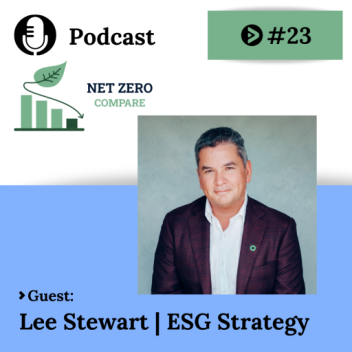
#23: Lee Stewart on How Companies Can Turn ESG Commitments Into Real Progress: Insights from Lee Stewart
In this episode
Executive summary
In this Net Zero Compare interview, Lee Stewart, CEO of ESG Strategy, explains why many companies struggle to turn ESG commitments into real operational progress. The issue, he argues, is rarely a lack of ambition. Instead, sustainability efforts often fail due to weak governance, poor data foundations, and over-reliance on small, overstretched sustainability teams. Stewart stresses that sustainable ownership must be distributed across the business, embedded in existing governance structures, and aligned with executive incentives. He introduces his “Triple C” framework: Confidence through board-level understanding, Commitment grounded in robust and customer-inclusive materiality assessments, and Consistency via clear accountability and incremental progress. He also highlights the growing importance of early preparation for sustainability reporting and assurance, warning that companies will increasingly face data demands from regulators and customers alike. Automation, careful data architecture, and future-ready systems are essential. Ultimately, Stewart encourages companies to treat compliance as an opportunity for efficiency, innovation, and competitive advantage. Consistent action, rather than perfect strategies or reports, is what drives meaningful ESG progress.
Many organizations today set ambitious sustainability goals, publish detailed ESG reports, and publicly commit to reducing their environmental and social impact. Yet translating these commitments into measurable, operational progress remains one of the most persistent challenges in the field.
To explore why this gap exists and what companies can do about it, we spoke with Lee Stewart, CEO of ESG Strategy, best-selling author of How to Build Sustainability into Your Business Strategy, and a sustainability practitioner with more than two decades of global experience advising boards and executive teams.
Throughout the conversation, Stewart offered clear, practical guidance on sustainability governance, data quality, reporting readiness, and organizational alignment. His message was consistent: most companies do not fail due to lack of ambition, but due to structural and operational barriers that prevent sustainability from becoming a fully integrated part of the business.
🎥 Watch our full interview: The full interview with Lee Stewart, CEO of ESG Strategy, is available on Net Zero Compare’s YouTube channel. In the conversation, Stewart expands on how companies can move from ESG ambition to real operational progress, why governance and accountability matter more than standalone targets, and how data quality and early reporting preparation reduce long-term risk. Watching the full discussion provides deeper insight into sustainability leadership, materiality decisions, incentive structures, and how organizations can embed sustainability into everyday business operations rather than treating it as a reporting exercise.
1. The Biggest Gap: Sustainability Still Rests on Too Few Shoulders
According to Stewart, one of the most common and damaging patterns is that sustainability functions are still heavily centralized. Companies often publish polished reports and ambitious targets, but execution falls on only a handful of individuals.
This creates burnout, high turnover, and ultimately stalled progress. Stewart emphasized that the ‘sustainability ownership’ must be distributed across the business, not confined to a single department or person. Executives and business units should directly manage pieces of the strategy and report to the board accordingly.
2. Before Strategy Comes Structure: Stewart’s Triple C Framework
Stewart distilled two decades of experience into a simple but effective model for embedding sustainability into business planning: Confidence, Commitment, and Consistency.
Confidence: Boards and decision-makers must understand key sustainability concepts before setting targets. Jumping ahead without context creates risk and weak execution.
Commitment: A meaningful, customer-inclusive materiality assessment anchors sustainability in real business priorities.
Consistency: Governance, accountability, and incremental progress ensure long-term follow-through.
3. Governance: Leverage What You Already Have
Many companies believe that advancing ESG requires building entirely new governance structures, hiring large teams, or implementing complex systems. Stewart warns that this mindset can stall progress before it even begins.
Most organizations already have foundational governance structures that can support sustainability efforts, such as health and safety committees, finance reporting routines, or operational management processes. Instead of replacing these, Stewart recommends enhancing them:
Add environmental oversight to existing committees.
Integrate sustainability into financial reporting workflows that already reach the board.
Support teams that have operational knowledge but lack resources to advance ideas.
Elevate employees with on-the-ground insights rather than creating parallel structures.
Stewart has seen factory and site teams propose practical, cost-saving sustainability ideas that would otherwise be overlooked. Good governance, he argues, is less about scale and more about alignment.
4. Materiality: Widen the Lens and Focus on What Truly Matters
Materiality assessments are often rushed or scoped too narrowly, resulting in strategies that do not reflect customer expectations or market realities. Stewart identifies two major mistakes:
1. Engaging too few stakeholders
He argues that a materiality assessment excluding customers or suppliers is incomplete and risks misalignment with revenue-driving expectations. Bringing customers into the conversation can reveal opportunities for new services, joint innovation, and competitive differentiation.
2. Trying to tackle too many priorities
Stewart is direct: no company can meaningfully pursue all 17 SDGs. Attempting to do so dilutes resources and leads to superficial progress. Instead, he advises organizations to choose three or four focus areas that align tightly with their business model, operational footprint, and customer needs.
A well-designed materiality process becomes a strategic asset. It sharpens focus, drives customer-centric thinking, and anchors sustainability efforts in real-world demand.
5. Reporting and Assurance: Early Preparation Creates Advantage
Mandatory sustainability reporting is expanding globally. Stewart notes that many companies underestimate the amount of preparation needed for future assurance and audit requirements.
Even organizations not yet regulated will soon be expected to provide emissions and risk data to larger customers that must meet stricter disclosure standards. Stewart is already helping large companies draft supplier questionnaires on emissions, modern slavery, waste, and climate risk.
He observes two types of businesses:
Reluctant compliers, who treat reporting as a nuisance and spend more time resisting than preparing.
Strategic adopters, who recognize that transparency builds resilience, strengthens customer trust, and creates competitive opportunities.
Companies that begin early can test their processes, refine data quality, and identify operational improvements well before audits become mandatory. Stewart views early action not as extra work but as risk reduction.
6. Data Quality: Automate, Simplify, and Build the Right Foundations
Data reliability remains one of the most persistent challenges for organizations at all stages of ESG maturity. Stewart outlined three practical recommendations:
1. Minimize manual entry
Manual data entry introduces errors and consumes time. Stewart encourages companies to automate inputs directly from utility providers, equipment, and operational systems. He shared examples of hotels switching to automated bill-scanning tools that feed energy data straight into dashboards for faster analysis and anomaly detection.
2. Don’t jump to software prematurely
Many organizations rush to purchase ESG software before understanding their data architecture. Stewart stresses that companies should first map what data they need, where it resides, and how it will be used. Only then should they select tools.
3. Design for the future, not just current requirements
Even if companies currently report only scope 1 and 2 emissions, future requirements will include broader scope 3 categories. Preparing early reduces disruption and avoids costly rework later.
Stewart notes that involving IT teams early is critical, as they already manage financial data integrity and can support ESG reporting structures as well.
7. Linking Sustainability to Financial Outcomes: Use Incentives That Drive Behavior
One of the most effective ways to integrate sustainability into business decision-making is to tie executive compensation to ESG performance. Stewart has seen this shift transform organizational behavior.
When even a small portion of bonuses depends on achieving emissions targets or meeting sustainability milestones, executives prioritize sustainability projects, allocate resources faster, and support cross-functional initiatives more actively.
This aligns sustainability work with the incentives that already govern corporate behavior. It also sends a clear internal signal that sustainability is not an optional add-on but a material business priority.
8. Compliance vs. Decarbonization: Treat Requirements as an Opportunity
Stewart acknowledges that many organizations still see compliance as a burden, but he emphasizes that reporting and disclosure requirements can serve as a catalyst for innovation and operational improvement.
Reporting forces companies to measure emissions, waste, and resource use with greater accuracy. These insights often reveal opportunities to:
Reduce energy costs
Improve equipment efficiency
Develop lower-carbon products
Strengthen customer and supplier collaboration
Identify areas for premium offerings, such as low-carbon materials
Stewart encourages leaders to visit operations firsthand to understand emissions sources and identify improvement opportunities. Customers increasingly demand transparency and low-carbon alternatives, and companies that connect compliance work to product value will be better positioned in their markets.
9. What Differentiates Companies That Make Real Progress
Some organizations make continuous strides in sustainability, while others repeatedly restart initiatives without gaining traction. Stewart says the difference often comes down to consistency and communication.
High-performing organizations:
Make incremental improvements regularly
Communicate progress to employees
Share challenges openly
Celebrate even small operational wins
Maintain long-term focus on their goals
Poor performers, by contrast, tend to lose momentum, fail to communicate internally, and revisit the same planning steps without moving into execution. Stewart’s advice is clear: sustainability is a long-term effort, and consistent progress is more important than perfection.
10. If Companies Focus on Only One Thing: Understand Your Impact and Purpose
When asked what single action drives the greatest long-term impact, Stewart offered a reflective question:
“If your business didn’t exist tomorrow, would society or the environment be better or worse off?”
He uses this question with leadership teams because it forces clarity around the organization’s purpose, values, and contribution to society. The responses often expose gaps between perceived and actual impact.
Stewart encourages organizations to use the answers to guide strategic priorities. If the business would not be missed, leaders should identify why and what must change. If it would be missed, those strengths should guide where the company focuses next.
Final Advice: Start Now, Even If It’s Small
Stewart closed the conversation with a simple message: do not wait for perfect data or perfect conditions. Companies already know many of the steps they need to take. The challenge is to act.
Walking the operations floor, identifying immediate opportunities, and making incremental improvements matter more than waiting for the perfect strategy. Progress comes from consistent action, not from additional reporting or theoretical planning.
Conclusion
Lee Stewart’s insights underline a central lesson: sustainability becomes meaningful only when embedded across the entire organization, supported by strong governance, reliable data, and practical execution. Ambition alone is not enough. Companies that operationalize sustainability, understand their impact, and build consistency into their processes will be better prepared for regulatory change and better positioned to meet customer expectations.
This conversation is part of the Net Zero Compare interview series, where we speak with leaders across sustainability, reporting, governance, and climate technology to help organizations navigate their decarbonization and compliance journey.
More from Net Zero Compare Podcast
#24: Andri Johnston on Digital Sustainability in Publishing: Practical Lessons from Cambridge University Press & Assessment

#22: Pini Reznik on Why AI Native Transformation Is About Structure, Not Tools
#21: Tom Schueneman on From Doom to Dialogue: How Climate Communication Can Reconnect People With Reality

#20: Mike Gifford on Digital Sustainability Starts with How We Build the Web
.png)
#19: Nina Benoit (Brightest) on How AI Is Transforming Sustainability Work