UK Battery Manufacturing Faces Strategic Test as Demand for EVs and Grid Storage Accelerates

Cut through the green tape
We don't push agendas. At Net Zero Compare, we cut through the hype and fear to deliver the straightforward facts you need for making informed decisions on green products and services. Whether motivated by compliance, customer demands, or a real passion for the environment, you’re welcome here. We provide reliable information. Why you seek it is not our concern.
Battery manufacturing has emerged as a strategic priority for the UK as electrification accelerates across transport, power generation, and industry. Batteries are essential to the rollout of electric vehicles, the integration of renewable electricity, and the resilience of energy systems increasingly reliant on intermittent sources such as wind and solar. As demand rises sharply, countries are competing to secure domestic manufacturing capacity and associated supply chains.
For the UK, the stakes are particularly high. Batteries underpin key net-zero objectives, including the phase-out of internal combustion engine vehicles and the expansion of renewable power. Without sufficient domestic capacity, the country risks increased dependence on imports, higher costs for manufacturers, and slower progress toward climate targets.
Global Competition for Battery Manufacturing Investment
Battery manufacturing is capital-intensive and globally competitive. Major economies have introduced targeted industrial policies to attract investment. The European Union has expanded state aid flexibility and coordinated battery value chain development, while the United States has introduced substantial incentives to localise battery and EV production.
By comparison, the UK has fewer operational gigafactories and a more limited pipeline of confirmed projects. Several announced investments have faced delays or uncertainty, underlining the challenges of securing long-term financing and policy alignment. Industry analysts warn that without rapid progress, the UK could fall behind peers that are moving faster to scale production.
Implications for the UK Automotive Sector
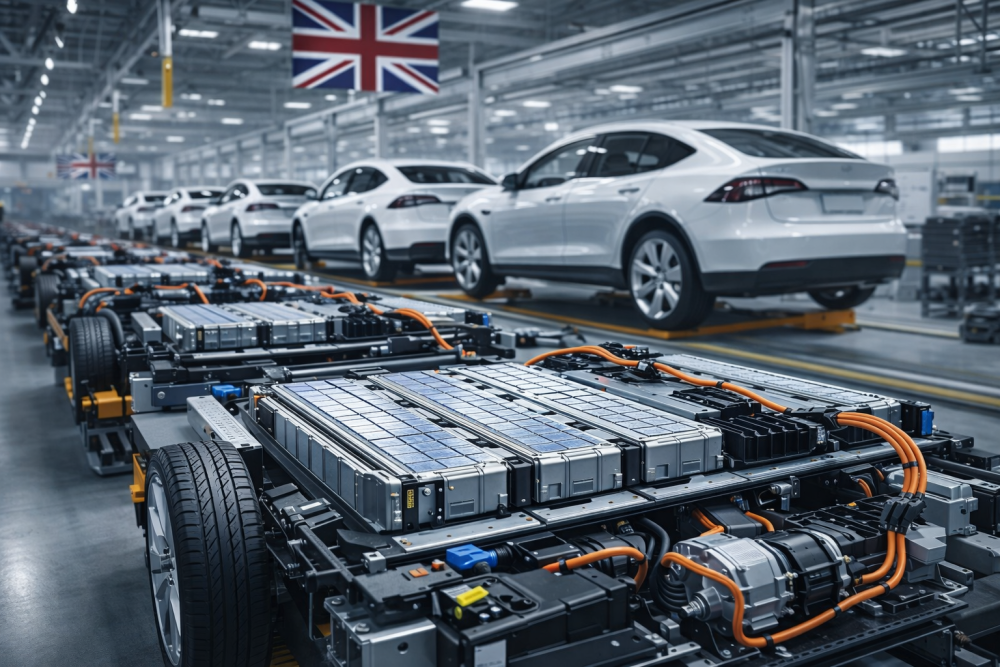
The automotive industry is one of the most exposed sectors. Electric vehicle production relies heavily on access to competitively priced batteries, which represent a significant share of total vehicle value. UK-based manufacturers need a secure local supply to remain cost-competitive and meet tightening emissions standards.
Trade rules add further pressure. Under the UK–EU Trade and Cooperation Agreement, stricter rules of origin for electric vehicles will apply from 2027. If vehicles assembled in the UK do not meet minimum local content thresholds, exports to the EU could face tariffs. Given the value of batteries within EVs, insufficient domestic battery production could undermine the viability of UK automotive manufacturing.
Energy Storage and Grid Resilience
Beyond transport, battery manufacturing is critical to the UK’s energy system. Grid-scale batteries play a growing role in balancing electricity supply, storing excess renewable generation, and providing flexibility during periods of low wind or solar output. As offshore wind and solar capacity expand, demand for energy storage is expected to increase substantially.
Domestic battery manufacturing can support energy security by reducing exposure to global supply chain disruptions and volatile international markets. It can also help accelerate deployment by shortening supply lines and aligning production with national infrastructure priorities.
Raw Materials and Supply Chain Challenges
Securing battery manufacturing capacity also requires reliable access to raw materials, including lithium, nickel, and cobalt. The UK has limited domestic resources and remains dependent on imports, often from geopolitically sensitive regions. This creates supply risks and exposes manufacturers to price volatility.
Developing battery recycling and reuse infrastructure is increasingly seen as part of the solution. Recycling can recover valuable materials, reduce reliance on primary extraction, and support circular economy objectives. As battery volumes grow, end-of-life management will become a critical component of a resilient supply chain.
Skills, Innovation, and Industrial Capability
Battery manufacturing depends on specialised skills spanning chemistry, engineering, automation, and digital systems. Scaling production requires a workforce capable of operating complex manufacturing processes and supporting continuous innovation.
The UK has strong research capabilities in battery science and advanced materials, supported by universities and innovation centres. However, translating research into large-scale industrial deployment remains a challenge. Coordinated investment in skills development, apprenticeships, and industrial training is essential to bridge this gap.
Policy Certainty and Operating Conditions
Industry stakeholders consistently highlight policy stability as a decisive factor for investment. Battery manufacturers seek long-term clarity on energy prices, planning frameworks, and market demand. High industrial electricity costs in the UK relative to other regions have raised concerns about operating competitiveness for energy-intensive manufacturing.
Clear industrial strategy alignment with net-zero goals, streamlined permitting processes, and targeted support for strategic supply chains are widely viewed as necessary to attract and retain investment. While government support mechanisms exist, their effectiveness will depend on speed, scale, and consistency.
Strategic Choices for the UK Economy
Battery manufacturing represents both a risk and an opportunity for the UK. Failure to act could weaken domestic automotive production, increase import dependence, and slow the transition to a low-carbon economy. Conversely, a coordinated approach combining investment, skills development, supply chain resilience, and supportive policy could position the UK as a competitive player in the global battery market.
As demand for batteries accelerates, decisions taken over the next few years will shape industrial competitiveness, energy security, and climate progress in the United Kingdom. Battery manufacturing is increasingly viewed not just as a climate issue, but as a cornerstone of long-term economic resilience.
Source: sustainabilitymag.com

Mentioned in this article...
More related content

OMV Warns Rigid Recycling Rules May Slow Plastics Innovation
Wind and Solar Overtake Fossil Fuels in EU Power Generation
OpenAI Outlines Strategy to Control Rising Data Centre Energy Costs