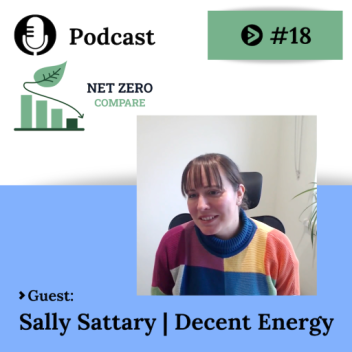
#18: Sally Sattary (Decent Energy) on Weather Intelligence, Forecasting Uncertainty, and Decarbonizing Energy Demand
In this episode
Executive summary
Weather is becoming one of the most important drivers of volatility in modern power systems. In this episode of the Net Zero Compare Podcast, Sally Sattary, Co-Founder and Director of Energy and Operations at Decent Energy, explains how weather forecasting, probabilistic models, and demand-side flexibility shape renewable-heavy grids. The conversation covers forecasting uncertainty, why fog and microclimates still disrupt solar output, the limits of deterministic forecasts, and where AI helps or falls short. Sally also introduces Decent Energy’s Shifter tool, which automates battery charging and discharging to reduce carbon intensity while lowering electricity costs for households.
Sally Sattary is the Co-Founder and Director of Energy and Operations at Decent Energy. With a background in meteorology, programming, and energy forecasting, she brings a practical understanding of how weather, demand, and renewable generation interact. In a recent conversation hosted by Net Zero Compare, she discussed forecasting uncertainty, probabilistic modeling, grid variability, and the challenges of building tools that support both decarbonization and user adoption.
🎥 Watch our full interview with Sally Sattary, Co-Founder and Director of Energy and Operations at Decent Energy, where she explains how weather intelligence shapes renewable-heavy power systems, why forecasting uncertainty matters for solar and storage, and how demand-side flexibility can reduce both electricity costs and carbon intensity.
Understanding the Path from Meteorology to Energy Operations
Sattary’s career began in meteorology, including work as a shift forecaster at MeteoGroup. She later supported Centrica’s trading desk as a meteorological data scientist, where she combined weather analysis with programming. That experience, followed by a career change and the need for more meaningful work, led to co-founding Decent Energy. Her path reflects a broader trend: forecasting expertise is increasingly relevant in power markets as renewable generation grows, and grid variability intensifies.
Why Demand-Focused Decarbonization Matters
Decent Energy’s core mission centers on “decarbonizing demand,” making renewable electricity more usable by shifting consumption to periods when low-carbon generation is available. Their approach supports two outcomes at once:
• lower electricity costs for households
• lower carbon intensity across the day
By aligning battery charging and discharging with renewable availability, customers use stored low-carbon energy later, when the grid mix is more carbon-intensive. This increases the value of renewables and reduces dependence on high-carbon generation during peak demand.
Weather Events That Decision Makers Still Underestimate
Sattary highlighted several meteorological patterns that are often misinterpreted by market participants:
Cold easterly spells and the fear of repeat extremes: Events like the “Beast from the East” still create disproportionate concern among traders who fear a repeat of 2018’s extreme price spikes. That tendency can distort the interpretation of otherwise normal weather signals.
Fog and its impact on solar output: Fog remains difficult to forecast and can significantly reduce expected solar production. Despite improvements in forecasting models, factors such as ground composition and local microclimates make fog clearance times uncertain. This can drive unexpected dips in real-time generation.
Microclimate variability: Local conditions, such as those in areas with chalk-heavy terrain, create additional deviations that system operators may overlook. As renewable penetration increases, smaller geographic anomalies have larger system-wide effects.
Managing Forecasting Uncertainty in High-Renewable Systems
Every energy forecast carries uncertainty, but solar forecasting is particularly sensitive to short-duration weather events. Sattary pointed to showers as a major source of error. Small changes in size, intensity, or movement can materially shift solar output curves.
Decent Energy reduces uncertainty through:
• blended forecasting models rather than a single deterministic output
• continuous comparison with actual generation
• probabilistic interpretation when feasible
Although the company’s tools ultimately require a single forecast line, the underlying process incorporates multiple model sources. This creates a more stable representation of expected generation while acknowledging inherent limits.
Forecasting Innovation for High Shares of Wind and Solar
For operators managing rising renewable shares, Sattary emphasized several advancements:
Higher-resolution numerical weather models: More detailed atmospheric modeling helps capture local patterns that influence short-term variability. Providers such as the Met Office and ECMWF continue to push resolution and accuracy forward.
Probabilistic and ensemble forecasting: Instead of relying on a single output, ensembles provide distributions that help identify risks and confidence levels. Percentile bands allow operators to plan for uncertainty rather than react to it.
Better translation from weather variables to power generation: High-quality algorithms are essential for converting irradiance, cloud cover, or wind speed into site-level generation forecasts. Even strong weather models can underperform if the weather-to-power layer is weak.
Where AI Helps and Where Organizations Should Be Cautious
Sattary noted that AI shows promise, but expectations must remain grounded.
Where AI adds value
• translating complex datasets into accessible explanations
• creating user-facing summaries of market or weather impacts
• helping non-technical stakeholders interpret forecasts consistently
AI can produce many different outputs at a speed that a single meteorologist cannot, which is valuable in some forms of energy trading, but still does not replace the nuanced skill that a meteorologist can bring.
Where caution is necessary
• assuming AI outperforms human meteorologists
• overestimating its ability to detect rare or extreme weather patterns
• relying on AI-generated forecasts without expert oversight
Experienced meteorologists can recognize subtle atmospheric patterns that models fail to detect. AI is most useful when used as a tool, not a replacement for deep subject-matter expertise.
Climate Variability and the Need for New Planning Strategies
Sattary described a loss of the predictable seasonal patterns that once guided long-term energy modeling. Trends such as:
• more frequent extreme weather events and a significant increase in the intensity of many events
• shifting hurricane/typhoon/tropical cyclone behavior
• unreliable seasonal norms
make traditional assumptions less accurate for planning. Seasonal forecasting and probability-based scenario analysis are becoming essential tools for long-term demand and supply planning.
Skills That Matter in the Energy Weather Intelligence Space
Beyond technical skills, Sattary emphasized mindset. Success requires recognizing that:
• different organizations contribute to the energy transition in different ways
• collaboration across technologies is necessary
• decarbonization involves cumulative improvements from many actors
This perspective helps align diverse stakeholders working toward shared climate goals.
Building Tools That Drive User Adoption
Decent Energy’s product design centers on translating carbon and cost savings into simple, everyday comparisons. Customers see their avoided emissions expressed as familiar items such as plastic bottles or cups of coffee. This makes carbon reduction tangible and actionable for non-expert users. The approach highlights an important lesson for all sustainability products: clarity improves adoption.
Shifter: Automating Demand Flexibility for Households
Sattary introduced Shîfter, Decent Energy’s open beta product. It connects directly to compatible inverters and automatically optimizes battery charging and discharging to:
• reduce carbon intensity
• lower electricity costs
• increase use of stored renewable energy
Early tests suggest potential bill reductions up to 50 percent, although results will vary with weather conditions and require further validation across seasons. The tool is designed to be simple and plug-and-play, supporting broader adoption of demand-shifting behavior.
Conclusion
Sally Sattary’s insights illustrate the growing importance of weather intelligence in managing renewable-heavy grids. As forecasting evolves, organizations benefit from probabilistic thinking, high-resolution data, and transparent methods for converting weather information into operational decisions. Decarbonizing demand through accessible, user-focused tools creates practical pathways for reducing emissions while lowering costs.
For decision makers navigating renewable variability, the combination of meteorology, data science, and user-centric design offers a clear direction: better forecasting, better translation of data, and better tools for end users.
Topics
More from Net Zero Compare Podcast
#24: Andri Johnston on Digital Sustainability in Publishing: Practical Lessons from Cambridge University Press & Assessment
#23: Lee Stewart on How Companies Can Turn ESG Commitments Into Real Progress: Insights from Lee Stewart
#22: Pini Reznik on Why AI Native Transformation Is About Structure, Not Tools
#21: Tom Schueneman on From Doom to Dialogue: How Climate Communication Can Reconnect People With Reality
#20: Mike Gifford on Digital Sustainability Starts with How We Build the Web
.png)