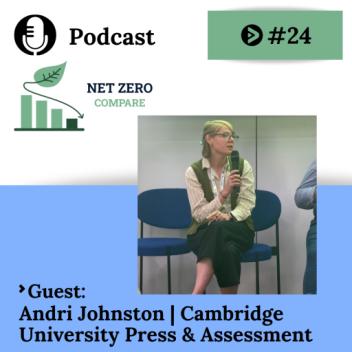
#24: Andri Johnston on Digital Sustainability in Publishing: Practical Lessons from Cambridge University Press & Assessment
In this episode
Executive summary
In a Net Zero Compare conversation, Andri Johnston, Digital Sustainability Lead at Cambridge University Press & Assessment, shared practical lessons on managing digital emissions in global publishing. While print remains the largest emissions source, digital products still generate impact through hosting, networks, and end-user access. Johnston emphasized acting without perfect data, documenting assumptions, refining methods, and using early estimates to drive momentum. Efficiency gains, such as reducing file sizes, optimizing image formats, and designing for low-bandwidth regions, delivered sustainability and accessibility benefits without harming learning outcomes. Supplier transparency, Scope 3 reporting gaps, and hardware lifecycles remain challenges, addressed through collaboration, governance, and circular IT practices. Cultural change, from Cleanathons to accessibility initiatives, proved essential. The key takeaway: digital sustainability is about continuous improvement, informed tradeoffs, and embedding efficiency into everyday digital decisions.
Digital sustainability is often discussed in the context of cloud computing, data centers, and software platforms. Publishing and education are rarely part of that conversation, despite operating global digital infrastructures and serving millions of users worldwide.
In a recent Net Zero Compare conversation, Andri Johnston, Digital Sustainability Lead at Cambridge University Press & Assessment, shared how one of the world’s largest academic and education publishers is approaching digital emissions, data quality, supplier engagement, and cultural change. The discussion focused on practical tradeoffs rather than theory, offering insights relevant to sustainability, ESG, and technology teams across industries.
🎥Watch the Full Conversation: The full interview with Andri Johnston, Digital Lead at Cambridge University Press & Assessment, provides additional technical detail and context around digital carbon measurement, internal governance, and day-to-day decision making inside a global education organization. Viewers can hear how assumptions are handled in practice, where the biggest uncertainties remain, and how teams translate sustainability goals into operational changes across digital products and infrastructure.
From Publishing to Digital Sustainability
Johnston’s path into digital sustainability did not follow a formal or predefined route. She began her career in publishing, later specializing in digital publishing and product management. Alongside this work, she developed a personal interest in sustainability and began educating herself through leadership courses and applied learning.
The turning point came during an internal sustainability event, where she encountered DIMPACT, a tool designed to measure the carbon impact of digital media products. What started as a side project during the COVID period evolved into a structured effort to assess emissions across Cambridge’s digital platforms. Several years later, this work led to the creation of a dedicated digital sustainability role, positioning Johnston as a bridge between publishing, technology, and environmental reporting.
Where Digital Publishing Emissions Come From
Within publishing, physical production still dominates total emissions. Paper, printing, freight, and warehousing account for the majority of the sector’s carbon footprint. Digital publishing generally produces lower emissions, often estimated at 50 to 80 percent less, depending on what is included in reporting boundaries.
That reduction, however, does not mean digital is impact-free. Johnston described three primary sources of digital emissions:
Content hosting, including data center energy use and long-term data storage
Network energy use, tied to internet infrastructure
End-user access, which varies by geography, grid intensity, and device type
While hosting emissions are typically reported because they involve paid services, emissions from user access fall under optional reporting categories in the Greenhouse Gas Protocol. Many organizations exclude them entirely. Johnston argued that responsibility does not disappear simply because emissions are harder to attribute. From her perspective, technology providers still have a duty to make products as efficient as possible.
Measuring Digital Emissions Without Perfect Data
Digital carbon accounting remains fragmented. Cloud providers use different methodologies, disclose limited location data, and often rely on market-based reporting. Early in Cambridge’s work, this meant making assumptions about data center locations and applying national grid factors manually.
Rather than waiting for standardized datasets, the organization documented its assumptions and refined them over time. Partnerships with third-party specialists later allowed the team to move toward ISO-certified methodologies for cloud emissions, reducing uncertainty and improving auditability.
Network energy use remains one of the least transparent areas. Organizations cannot reliably determine how users access content or the energy intensity of local infrastructure, particularly in data-poor regions. As a result, global averages are still used, with the understanding that accuracy varies by region.
Johnston emphasized that waiting for perfect data often leads to inaction. Even imperfect numbers can unlock executive attention, investment, and internal momentum, as long as assumptions are clearly disclosed.
Improving Digital Products Without Sacrificing Learning Outcomes
Reducing emissions does not require eliminating digital features. Instead, Johnston described a focus on efficiency. Small design and engineering choices can have measurable effects, particularly at scale.
Examples include reducing file sizes, rethinking image formats, and avoiding unnecessarily high-resolution media. Switching from older image formats to more efficient alternatives, such as WebP, reduced data transfer without affecting perceived quality. Teams were also encouraged to question whether additional media actually supported learning outcomes, especially for users in regions with limited connectivity.
Designing for a global audience changed internal thinking. Content that loads easily in Europe may be inaccessible elsewhere. Efficiency, in this sense, became both a sustainability and equity issue.
Supplier Engagement and the Limits of Transparency
Engaging suppliers remains one of the most difficult aspects of digital sustainability. Many software vendors report only Scope 1 and Scope 2 emissions, while ignoring the emissions generated by customers using their services. For buyers, this leaves a critical gap in Scope 3 reporting.
Participation in industry groups such as DIMPACT allowed Cambridge to collaborate with peers, develop shared documentation, and collectively pressure suppliers for better disclosures. Responses varied widely. Some suppliers were prepared and willing to engage. Others claimed digital services had no footprint at all.
According to Johnston, progress is constrained by the lack of formal guidance in emissions accounting standards for digital services. Until reporting expectations become clearer, supplier transparency will remain inconsistent.
Governance, Accountability, and Organizational Structure
Cambridge University Press & Assessment operates as part of the University of Cambridge and aligns its Scope 1 and Scope 2 targets with the university’s science-based commitments. Sustainability oversight is embedded at the board level, ensuring that progress is reviewed regularly rather than treated as a side initiative.
Beyond formal governance, Johnston highlighted the role of internal culture. Employees actively hold leadership accountable, driven by the organization’s educational mission and not-for-profit structure. While challenges remain in embedding sustainability into product-level KPIs, institutional commitment has enabled the creation of dedicated roles and long-term programs.
Hardware, Lifespan Extension, and Circularity
IT hardware represents a major blind spot in digital emissions. Historically, device replacement cycles were driven by performance expectations rather than environmental considerations. That mindset has begun to shift.
At Cambridge, policies now favor refurbishment, redeployment, and extended device lifetimes. While manufacturers often recommend replacement after four to five years, many devices remain functional beyond that point. The main constraint comes from software requirements that render older hardware incompatible; an issue Johnston views as a regulatory challenge rather than one that organizations can solve alone.
End-of-life management also matters. Even when devices leave an organization, their emissions remain part of its footprint. Recycling and donation programs, rather than disposal, reduce both environmental impact and reporting risk.
Culture, Habits, and Measurable Change
Cultural adoption proved as important as technical measures. Much of Johnston’s early work involved internal education, explaining what digital sustainability means in practical terms. Over time, individual champions emerged within teams, driving localized change.
One example was a company-wide digital Cleanathon run by her team. Employees were encouraged to reduce unnecessary file storage and email retention. The initiative delivered measurable reductions in storage-related emissions and improved productivity. The exercise also reinforced the idea that everyday digital habits carry environmental consequences.
Accessibility as a Sustainability Lever
Johnston argued that accessibility and sustainability are closely aligned. Accessible products are typically more efficient, requiring fewer steps, less data transfer, and clearer user journeys. In practice, accessibility improvements often led to measurable reductions in emissions.
Guidelines such as WCAG and emerging web sustainability standards reinforce this overlap. Teams working on accessibility initiatives consistently delivered sustainability benefits, even when emissions reduction was not the primary goal.
Practical Starting Points for Organizations
For organizations beginning their digital sustainability work, Johnston outlined a flexible approach. Measurement, target setting, and improvement are the ideal sequence, but not always feasible in that order. Where measurement is difficult, improvement can still begin.
Simple actions include reviewing page weights, optimizing media formats, and applying established sustainable web design practices. Free tools can provide directional insight, while more advanced assessments can follow once internal capability grows. Cloud optimization, while important, is rarely the best place to start due to complexity.
AI, Efficiency, and Emerging Risks
The conversation concluded with AI. Johnston drew a clear distinction between using AI to support sustainability goals and addressing the sustainability impact of AI itself. While AI can improve measurement and optimization, it also introduces significant energy demand.
Rather than rejecting AI, Johnston emphasized efficiency. Model choice, prompt design, and infrastructure decisions all influence emissions. Treating AI as part of the broader digital sustainability framework, rather than a separate category, will be critical over the coming years.
Conclusion
Digital sustainability in publishing is not about eliminating digital services. It is about understanding where emissions occur, making informed tradeoffs, and improving efficiency across systems that operate at a global scale.
The experience at Cambridge University Press & Assessment shows that progress is possible without perfect data, provided assumptions are transparent, and improvement is continuous. For organizations navigating ESG reporting, Scope 3 uncertainty, and digital transformation, the lessons extend far beyond publishing and apply to any company building and operating digital products today.
More from Net Zero Compare Podcast
#23: Lee Stewart on How Companies Can Turn ESG Commitments Into Real Progress: Insights from Lee Stewart

#22: Pini Reznik on Why AI Native Transformation Is About Structure, Not Tools
#21: Tom Schueneman on From Doom to Dialogue: How Climate Communication Can Reconnect People With Reality

#20: Mike Gifford on Digital Sustainability Starts with How We Build the Web
.png)
#19: Nina Benoit (Brightest) on How AI Is Transforming Sustainability Work