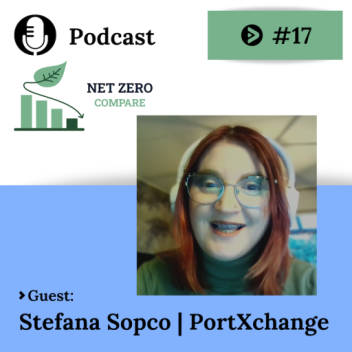
#17: Stefana Sopco (PortXchange) on Data, Digital Coordination, and Port Decarbonization
In this episode
Executive summary
Ports play a central role in maritime emissions, but most already have the data needed to act. In this conversation, Stefana Sopco of PortXchange explains how ports can reduce Scope 3 emissions through better data sharing, just-in-time arrival coordination, and transparent reporting. The discussion covers practical decarbonization levers, the limits of technology without collaboration, and why inclusive leadership and community accountability matter for accelerating real progress.
Introduction
Stefana Sopco, Marketing Manager at PortXchange, brings a multidisciplinary perspective to port decarbonization. Her work spans green technology in shipping, digital innovation for port authorities, and advocacy for diversity and inclusion in maritime and tech sectors. This conversation, hosted by Net Zero Compare, explores the practical levers ports can use to reduce emissions, the data challenges slowing progress, and the cultural shifts needed to accelerate the energy transition.
Watch the Full Interview: The full conversation offers additional nuance on port operations, digital tools, community expectations, and the industry’s internal barriers to change. For professionals working in maritime sustainability, ESG, compliance, or digital transformation, the video provides context that complements the analysis below.
How Ports Can Drive Decarbonization: Insights from PortXchange
A Sector With the Data It Needs but Not Yet the Action
Sopco emphasizes that most ports already possess the necessary data to reduce emissions. The challenge is collective action, not information scarcity. According to her, data remains siloed across ports, terminals, shipping customers, and logistics partners. These protectionist practices prevent real operational improvements.
High-quality, shared datasets are essential for meaningful decarbonization. The industry’s fragmented approach to data also limits the usefulness of AI. Without consistent, collectively held information, advanced analytics cannot produce reliable insights.
PortXchange positions itself as a technology provider that supports secure data sharing and builds trust through clear data ownership rules. Its products, such as Emission Insider, allow port authorities to monitor Scope 3 emissions from vessels and, soon, from trucks and rail. The company also advocates publicly for universal data sharing standards across maritime stakeholders.
Key Levers for Near-Term Emissions Reductions
1. Real-Time Supply Chain Synchronization
A major source of emissions is unnecessary fuel burn due to poor coordination. Without visibility into real-time estimated times of arrival, terminals, shipping lines, and hinterland operators operate inefficiently. Sopco notes that synchronization is fundamentally a data challenge. Analytical tools can identify delays and hotspots, but only if stakeholders share information.
2. Vessel Turnaround Optimization
Fifty to sixty percent of port-related Scope 3 emissions come from vessels at berth or waiting at anchorage. Ports like Rotterdam experience this daily. PortXchange has delivered successful use cases for just-in-time arrival protocols, enabling better coordination of ship movements through improved data sharing and arrival planning. Some ports have also implemented additional tools, such as weather and traffic data integration, as part of their broader operational setups.
3. Electrifying Port Equipment and Vehicles With Measurement
Electrification remains a common investment, but Sopco cautions that without measurement, it risks being treated as a communications exercise rather than a decarbonization strategy. She points out that reductions from electrifying trucks can be overshadowed if cruise ship traffic increases. Measurement, verification, and transparent reporting must accompany electrification projects.
Incentives, Community Pressure, and Accountability
Decarbonization is an ecosystem effort involving regulators, communities, investors, ports, and shipping customers. Sopco refers to the European Sea Ports Organization environmental report, which identifies climate change, air quality, and energy efficiency as top port priorities.
She highlights examples such as Belfast Harbor, where Scope 3 emissions are reported voluntarily. Their transparency stems from strong ties to local communities rather than regulatory demands. According to Sopco, community pressure is a powerful lever because ports directly affect nearby residents, air quality, and local ecosystems.
PortXchange is currently analyzing environmental reports from ports to identify greenwashing. Early findings show many commitments made one year are not followed through the next, often due to political pressures or discomfort with reporting unfavorable results. Consistent accountability remains a gap across the sector.
Digital Coordination and the Role of AI
Sopco sees just-in-time arrivals and data sharing as foundational to decarbonization. Industry events still repeat the same discussions year after year, despite available technology and data. She notes significant inconsistencies in emissions definitions and reporting practices, making cross-organization collaboration difficult.
AI tools are not the bottleneck. The industry’s limited data availability and lack of standardization are the primary barriers. Without shared, accurate data, AI cannot deliver meaningful guidance for emissions reduction.
Why Diversity and Inclusion Matter for Decarbonization
Sopco argues that decarbonization is a systemic and organizational transformation and therefore requires diverse leadership. Homogeneous leadership teams, particularly those dominated by men, lack the full perspective needed to address climate challenges. She stresses that the people most affected by climate change, including women, young generations, indigenous communities, frontline workers, and marginalized groups, are still largely excluded from decision-making.
She also notes that both maritime and tech sectors tend to gatekeep capital, strategic decisions, and definitions of sustainability. True momentum requires including diverse voices before strategies are set, not merely inviting them to panels after decisions have been made. Inclusive co-leadership structures can lead to more credible and community-aligned sustainability outcomes.
Obstacles Slowing Progress
Data Gating and Inaction
Data withholding is expected, but Sopco is continually surprised by the industry’s reluctance to act despite having tools and urgency. Slow decision-making affects not only decarbonization but also talent attraction. Younger generations expect impact, results, and visible movement. Persistent bureaucracy and risk aversion discourage new entrants.
Reluctance to Challenge Existing Structures
Fear of being seen as disruptive or activist delays needed change. Sopco sees this cultural hesitation as a barrier that undermines the industry’s long-term competitiveness and ability to recruit emerging talent.
Trends to Watch in Maritime Decarbonization
Technology is not the missing element. The market already has mature solutions that can accelerate emissions reductions. What Sopco hopes to see is broader adoption and implementation of these existing tools.
PortXchange was recently shortlisted as a top three green tech company in the European SME Awards and named Europe’s leading digital emissions monitoring platform for 2026. This recognition reflects the momentum of digital tools in port sustainability.
From a regulatory perspective, she notes delays from international bodies and inconsistent political signals. Relying on regulation alone is risky given current geopolitical dynamics. This is why PortXchange increasingly communicates directly with banks, which play a central role in financing port innovation.
Guidance for Practitioners Entering Port Decarbonization
Sopco’s advice for advisors, developers, and sustainability professionals includes:
• Focus on impact and purpose
• Prioritize work that contributes to measurable emissions reductions
• Bring sharp, values-driven perspectives
• Build strong industry networks
• Participate actively at events and question assumptions
• Avoid defaulting to the status quo
Port transformation requires people willing to challenge norms and contribute original thinking.
Final Perspective
Sopco encourages sustainability professionals to question information in the age of AI-generated content. Even large organizations use automated tools for reporting, which makes independent verification essential. Staying informed and asking critical questions will remain important as digital tools proliferate and expectations for transparency rise.
Topics
More from Net Zero Compare Podcast
#24: Andri Johnston on Digital Sustainability in Publishing: Practical Lessons from Cambridge University Press & Assessment
#23: Lee Stewart on How Companies Can Turn ESG Commitments Into Real Progress: Insights from Lee Stewart
#22: Pini Reznik on Why AI Native Transformation Is About Structure, Not Tools
#21: Tom Schueneman on From Doom to Dialogue: How Climate Communication Can Reconnect People With Reality
#20: Mike Gifford on Digital Sustainability Starts with How We Build the Web
.png)