

Available Carbon Accounting Features
Missing Carbon Accounting Features
Pricing
Starting Price
Options
Available Since
Deployment Options
Good Option For
Deep dive
Core Features
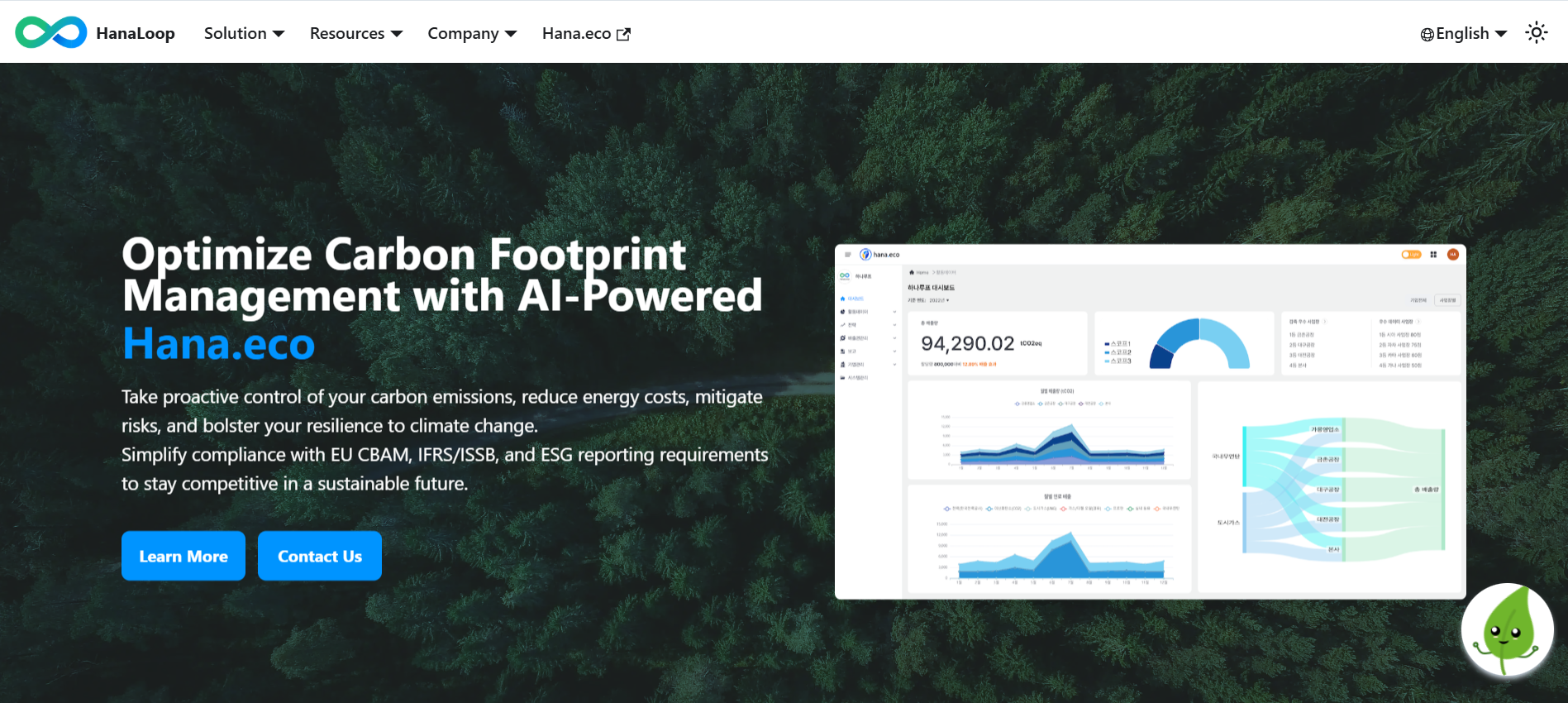
Full-scope Carbon Accounting (Scopes 1, 2 and 3): Hana.eco quantifies greenhouse-gas emissions across all three scopes, converting activity data into CO₂-equivalent emissions. It supports automated data collection, calculation, verification-grade evidence management and report generation, with a calculation engine aligned to the GHG Protocol and compliant with K-ETS requirements
EU CBAM & Korea ETS Compliance: A central focus is regulatory compliance. Hana.eco provides dedicated modules for EU CBAM and the Korea Emissions Trading Scheme, including product and precursor management, emission-factor catalogues, target setting, allocation and emissions-trading support. The platform is described as the first to obtain verification from Lloyd’s Register / LRQA for compliance with both K-ETS and EU CBAM, positioning it as a trusted solution for exporters in sectors like steel, non-ferrous metals and automotive.
Product Carbon Footprint (PCF) & LCA-Based Process Modelling: Hana.eco includes a product carbon-footprint module that quantifies emissions from raw-material extraction through production, distribution, use and end-of-life, following standards such as ISO 14067 and the GHG Protocol. It supports process-flow-based modelling, embedded-emissions management in raw materials and identification of high-impact processes, enabling companies to build reduction strategies at the product and process level.
ESG & Disclosure Framework Support: The platform helps companies prepare data for multiple ESG standards and climate-disclosure frameworks. It explicitly supports IFRS/ISSB S1 and S2, TCFD-style strategy and risk-governance disclosures, as well as CDP and GRI emissions sections (e.g. CDP C4–C8 modules covering targets, initiatives, emissions data, breakdowns and energy).
Scope 3 & Value-Chain Management: Hana.eco is built to manage emissions across the value chain. It offers supplier and partner management capabilities, industry-standard emission factors, and multiple calculation approaches for Scope 3, such as supplier-specific, hybrid and spend-based methods. Multilingual support is highlighted for working with overseas partners
AI-Based Carbon Intelligence (Hana.eco AI & CarbonBuddy)
Hana.eco integrates several AI functions:
Automatic emission-factor mapping by clustering activity data and assigning the most appropriate emission factors.
Anomaly detection to flag outliers and improve data accuracy.
Data prediction and scenario analysis to forecast emissions, assess financial impacts under ETS/CBAM and evaluate reduction effects from activity changes.
CarbonBuddy AI assistant, a generative-AI chatbot that uses RAG and an internal index to provide reliable answers on regulations, emissions trading and climate strategy, aimed at non-experts.
Collaboration & Workflow: The platform supports collaboration between the environment, ESG, strategy teams, consultants and third-party verifiers. Features include role- and permission-based access, messaging between users, custom reporting tools and workflows designed to streamline verification and audit processes.
Connectors & Open API: Hana.eco provides connectors and open APIs to simplify data collection from external systems. In Korea, it can automatically retrieve electricity-use data via integration with the national power utility (KEPCO), reducing manual entry effort. More broadly, connectors and APIs are designed to automate data flows from corporate systems into the carbon accounting engine.
Strategy, Targets & Climate-Risk Analysis: Beyond measurement, the platform supports target-setting, cost-effectiveness analysis of reduction projects and climate-risk monitoring. Statistical models and AI are used for goal management, and scenario analysis helps companies understand the implications of different emissions pathways and carbon-price or regulatory conditions.
Plans & Pricing
HanaLoop does not publish detailed pricing on the English site. The solution is described as a cloud-based SaaS platform with tailored service options according to company needs, industry and regulatory exposure. Implementation typically includes:
platform subscription;
configuration of ETS/CBAM modules;
support for PCF and Scope 3;
optional consulting and training services.
Given its target sectors (heavy industry, exporters, manufacturers), pricing is likely enterprise-oriented and scoped by the number of facilities, products, jurisdictions and users rather than a fixed public tariff.
Integrations
Hana.eco focuses on data connectors and APIs rather than long lists of off-the-shelf app integrations. Key integration patterns include:
Utility & energy data: automated electricity-consumption data collection (e.g. KEPCO integration) for Scope 2; Corporate systems: ingestion of activity data and evidence from internal systems via connectors and APIs;
Regulatory systems: preparation of data for submission to national ETS portals, CBAM reporting and other regulatory channels.
These integrations are aimed at reducing manual data work, improving audit trails and enabling near-real-time reporting.
Certifications & Awards
LRQA / Lloyd’s Register verification: Hana.eco is promoted as the first platform to receive LRQA verification for compliance with both the Korea Emissions Trading Scheme and EU CBAM requirements, signalling external validation of its methodology and functionality for these regimes.
.eco Community Membership: HanaLoop holds a hana.eco .eco domain profile, activated in February 2023, and a separate vidaloop.eco profile activated June 2025, reflecting ongoing climate-action commitments.
No ISO certifications (e.g. ISO 14064 or ISO 14067 accreditation for the tool itself) are publicly listed as of now; however, the PCF module explicitly references ISO 14067 and GHG Protocol standards.
Expert Voices & Reviews
The International Centre for Hydropower highlights HanaLoop as a member providing an online platform that streamlines climate-data collection, emissions tracking, target setting and compliance with ETS, CBAM and IFRS S1/S2.
Smart Maritime Network describes a 2025 partnership between HanaLoop and MarinaChain to support carbon management for shipping, logistics and manufacturing clients, emphasising AI-driven digital applications and regulatory compliance.
Korean business and industry media present Hana.eco as a digital carbon-management platform that strengthens companies’ ability to respond to global climate regulation, particularly IFRS S1/S2, EU CBAM, DPP-related requirements and California SB 253.
These references underline HanaLoop’s positioning as a specialist compliance and industry-grade carbon-management provider.
Customers & Case Studies
HanaLoop does not maintain an English case-study section, but external sources and Korean-language content reveal example customers and sectors:
Apollo Industry (beauty packaging): news coverage describes Apollo Industry introducing HanaLoop’s carbon-management platform to advance ESG management in the beauty packaging sector.
Sam-A Aluminium and Byucksan: Korean media and career-site profiles reference HanaLoop supporting CBAM and carbon-management solutions for metal and building-materials companies.
Shipping and logistics: the partnership with MarinaChain targets shipping, ports, logistics and heavy industries, integrating both platforms for improved emissions calculations and regulatory reporting.
Overall, Hana.eco appears to be particularly strong in heavy industry, metals, automotive, building materials and export-oriented manufacturers subject to K-ETS and CBAM.
Closing Insights
Hana.eco is a regulation-first, AI-enabled carbon-management platform with a clear niche: helping industrial companies and exporters handle complex climate rules such as K-ETS and EU CBAM while building a robust corporate and product-level carbon-accounting backbone.
Strengths:
Deep alignment with K-ETS and CBAM, backed by LRQA verification.
Combined corporate and product-level capabilities (Scopes 1–3 plus PCF).
AI features that tackle pain points like emission-factor mapping, anomaly detection and predictive analysis.
Strong support for IFRS/ISSB S1–S2 and CDP/GRI climate reporting needs.
Collaboration and verification-friendly workflows that fit companies working with external auditors and consultants.
Limitations & Considerations:
The platform is oriented primarily around carbon and climate risk, not a full ESG suite (social and governance coverage is more limited).
Most documentation and ecosystem content are still Korean-centric, which may be a barrier for some international users, even though English and Spanish interfaces exist.
For companies whose focus is product LCA beyond carbon (multi-impact environmental footprinting), a dedicated LCA tool may still be required alongside Hana.eco.
For organisations operating under K-ETS, exposed to EU CBAM or preparing for IFRS/ISSB climate disclosures, Hana.eco is a strong, specialised choice. For companies mainly seeking high-level ESG dashboards or generic sustainability reporting, it may be more than they need or best used as the carbon backbone within a broader ESG stack.