

Available Supply Chain Sustainability Features
Missing Supply Chain Sustainability Features
Pricing
Starting Price
Options
Available Since
Deployment Options
Good Option For
- Small Business (11-50 people)
- Medium Business (51-250 people)
- Large Business (250+ people)
Deep dive
Core Features
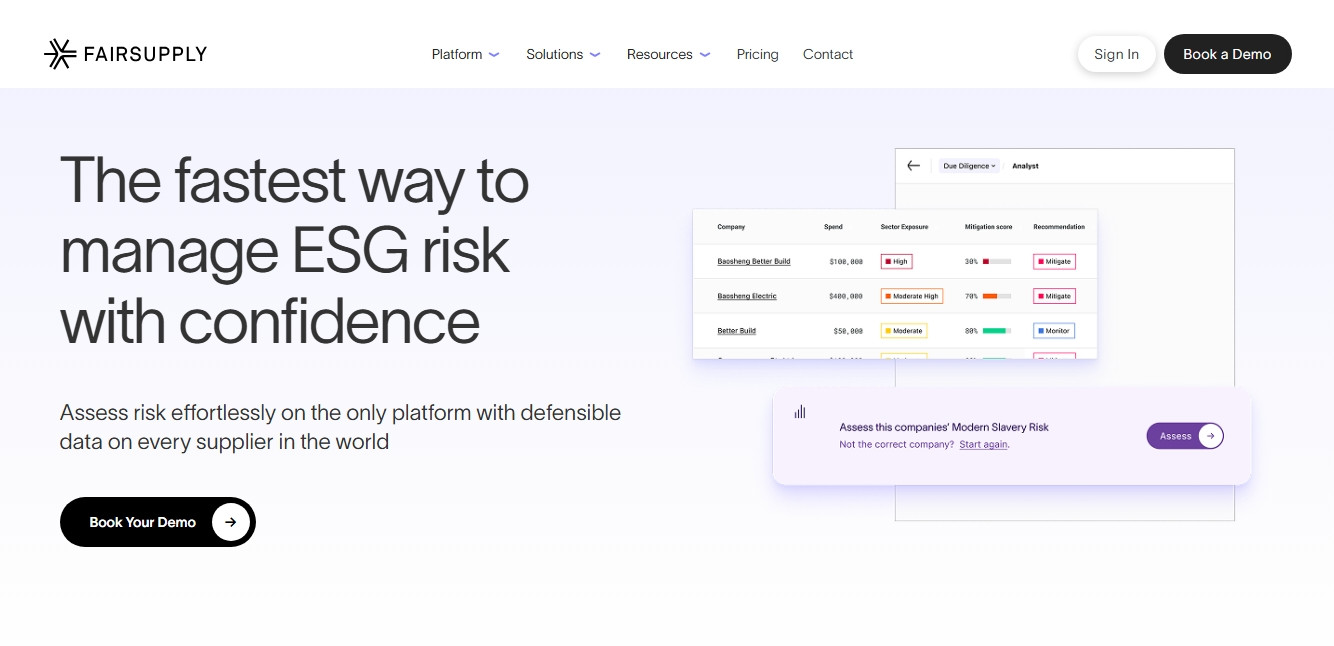
Fair Supply’s methodology centers on using supplier spend and global economic datasets to create a repeatable, auditable view of upstream exposure (including multi-tier risk), then layering engagement and evidence collection where a deeper review is required. Some of its main features are:
Ten-tier supplier visibility — Maps ESG risk exposure beyond Tier 1, with “10 tiers deep” positioning for supplier risk discovery.
Objective risk scoring — Combines economic modelling, external datasets and company data to produce repeatable risk scores and review flags.
SAQ-based supplier engagement — Pre-built, tailorable SAQs aligned to modern slavery, emissions and biodiversity, with engagement history recorded for audit/reporting.
Audit-ready ESG reporting — Turns assessments and engagement evidence into structured reporting workflows, with templates aligned to major regulations and frameworks.
Scope 1–3 accounting workflow — Scope 1–2 calculators plus Scope 3 screening from procurement spend; outputs are positioned for formal disclosures.
Biodiversity and trade risk modules — Adds biodiversity impact screening (including supplier nSTAR references) and a tariff calculator for trade policy cost exposure.
Closing Insights
Fair Supply started in 2019, when human rights lawyer Kimberly Randle partnered with mathematician Dr Arne Geschke to quantify upstream ESG exposure using global trade data. The platform uses Multi-Regional Input-Output (MRIO) modelling so teams can screen suppliers from supplier name and spend and see risk signals deep in the supply chain. Supplier questionnaires and logged engagement capture evidence where screening indicates higher exposure. Fair Supply Analyst adds supplier-specific signals from third-party sources alongside modelling.
Case studies show use in practice: Ramsay Health Care, Jemena, and SHoP Architects describe using Fair Supply to surface modern-slavery, emissions, and nature-related risks and support due diligence and reporting. Fair Supply reports ISO/IEC 27001 certification for its information security management system and lists awards including a TMRRW Awards AU/NZ win and recognition at Regulation Asia and APAC Insider. Pricing isn’t published as a flat rate; it varies by functions, solutions, and supply-chain scale.