

Available Carbon Accounting Features
Missing Carbon Accounting Features
Pricing
Starting Price
Options
Available Since
Deployment Options
Good Option For
- Medium Business (51-250 people)
- Large Business (250+ people)
Deep dive
Core Features
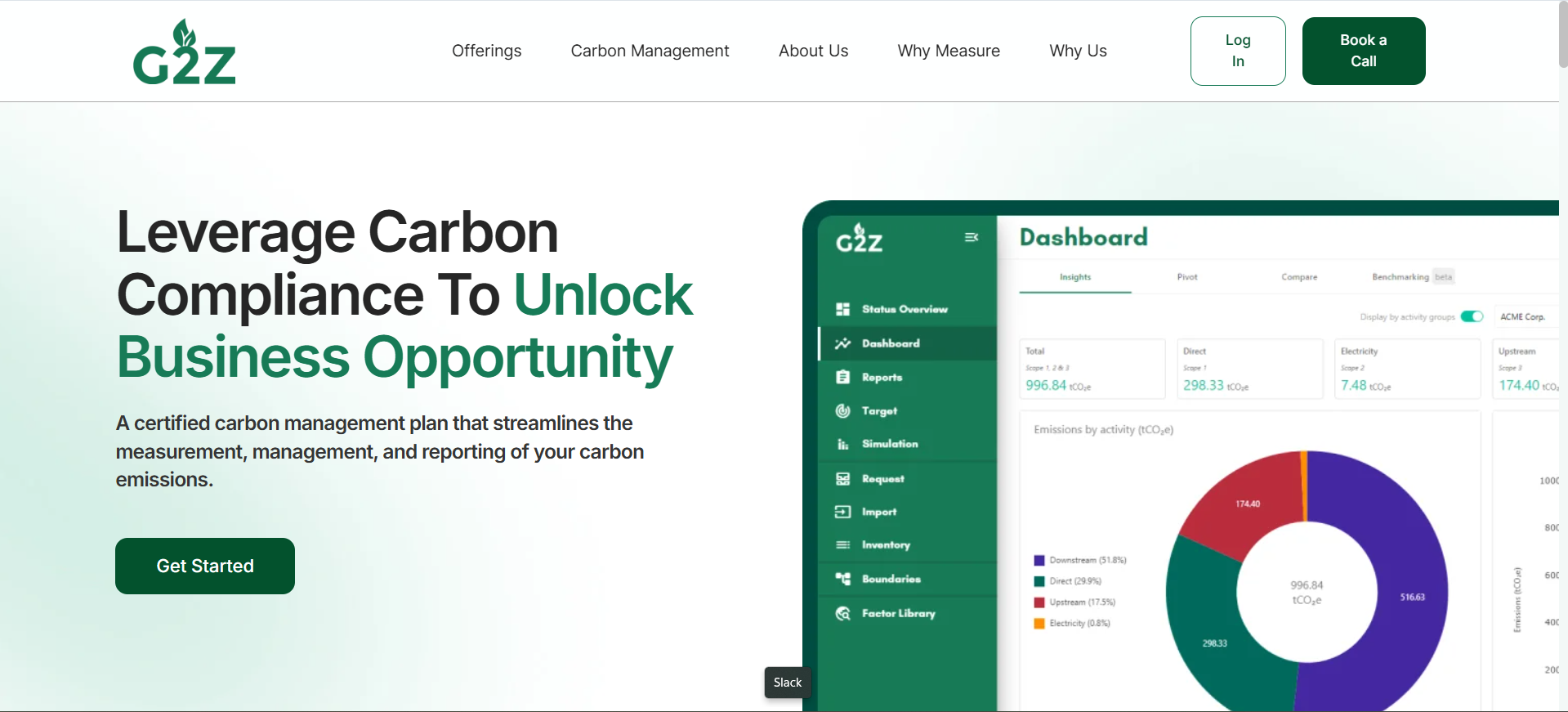
Comprehensive Carbon Emissions Accounting (Operations + Value-Chain): G2Z enables companies to account for greenhouse-gas emissions across their operations and entire value chain, including upstream and downstream emissions.
AI-Powered Data Handling & Emissions Calculation: According to G2Z, the platform applies AI, machine learning algorithms, and data-processing workflows to automate parts of emissions calculation, data collection, and reporting, reducing manual workload and enabling more scalable carbon management.
Structured Decarbonization & Reporting Workflow: The platform offers a step-by-step decarbonization process: baseline emissions measurement, emissions data aggregation, analytics and reporting support, and target-setting for reduction strategies.
Supply-Chain & Value-Chain Emissions Integration: G2Z claims to support value-chain emissions accounting, enabling companies to manage not only their direct emissions but also emissions related to procurement, suppliers, upstream/downstream activities, enhancing supply-chain transparency.
Consulting-Style Services + Software - Hybrid Approach: Beyond pure software, G2Z appears to bundle consulting support, guidance, and reporting services, useful for companies that lack internal sustainability or carbon-accounting expertise.
Regulation & Compliance Intelligence: G2Z describes itself as a “climate regulation intelligence platform,” suggesting it also helps clients stay updated with regulatory requirements, reporting standards, and compliance obligations, potentially valuable for companies operating under evolving ESG and sustainability regulations.
Plans & Pricing
G2Z’s website does not publicly list transparent, standardised pricing tiers. The offering appears customised: companies likely receive tailored quotes depending on scope, size, and support required (value-chain coverage, consulting, data complexity). Because of this, the platform may be more suitable for medium to large enterprises or companies with complex value chains, rather than very small firms.
Integrations & Output
G2Z integrates data across company operations and suppliers, handling emissions data aggregation from multiple sources. It provides reporting capabilities likely compatible with global ESG frameworks, facilitating disclosures, regulatory compliance, and internal tracking.
The platform’s use of AI and data automation suggests potential for scaling, periodic updates, and managing large data volumes, which helps in complex value chains and global supply networks.
Certifications & Methodology
While G2Z claims compliance and “certified carbon-management plan” offerings, there is no publicly visible documentation (on their website) showing independent verification, third-party certification, or published methodology aligned with global standards (e.g., GHG Protocol, ISO 14064, or similar).
Potential clients should request methodological transparency and auditability before relying solely on G2Z for regulatory reports or external disclosures.
Customers, Use Cases & Target Users
G2Z targets:
Companies with complex value chains need full emissions accounting
Firms lacking internal sustainability teams (seeking hybrid tool + consultancy)
Organisations preparing for regulatory compliance or ESG reporting
Sustainability consultants using G2Z as a client-facing delivery tool
Use cases include baseline emissions accounting, value-chain emissions mapping, decarbonization strategy building, ESG disclosure support, regulatory preparation, and reporting.
Closing Insights
Strengths:
Broad scope: operations + value-chain emissions: few tools combine both with claims of AI support.
Hybrid model: software + consulting support: useful for companies with limited internal expertise.
Flexibility and scalability for complex supply-chain organisations.
Potential support for regulation compliance and ESG reporting workflows.
Limitations & Considerations:
Lack of public methodological transparency or third-party verification may limit credibility in external disclosures.
Custom pricing may be expensive for small firms or firms with limited data infrastructure.
Dependence on quality of input data from suppliers and value-chain: data gaps or low data quality may impair outputs.
As with many value-chain tools, complexity grows with supply-chain depth, requiring strong data governance to be effective.
Best-Fit Users:
Mid-to-large enterprises, manufacturing or retail companies with complex supply-chain networks, firms preparing for ESG/regulatory compliance, and organisations lacking dedicated sustainability staff but needing reliable emissions data and value-chain transparency.