
Available Supply Chain Sustainability Features
Missing Supply Chain Sustainability Features
Pricing
Starting Price
Options
Available Since
Deployment Options
Good Option For
- Medium Business (51-250 people)
- Large Business (250+ people)
Deep dive
Core Features
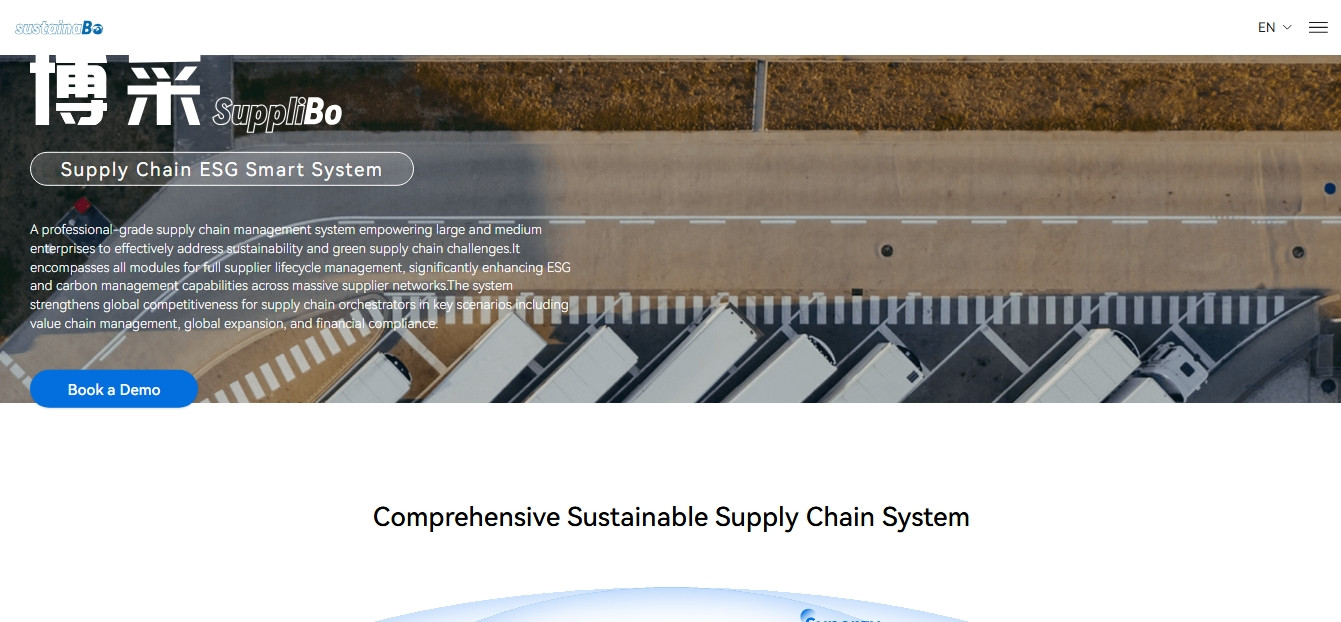
SuppliBo treats supply-chain sustainability as a governed process: it links supplier requirements and decision rights to structured lifecycle workflows, aiming to make ESG expectations consistent across large supplier bases—especially in value-chain management, cross-border operations, and compliance-heavy contexts. From that foundation, some of its main features are:
Supplier assessment and onboarding — supports supplier invitation, qualification assessment, CSR/environment checks, and formal sign-off steps such as codes of conduct and compliance declarations.
Supplier screening and selection — includes “smart selection” of project suppliers and combines ESG factors with broader assessments such as TCO and “diverse assessment.”
Performance and portfolio management — tracks supplier performance (including ESG-weighted views) and supports onboarding/development/elimination decisions plus remediation and improvement management.
Due diligence and approvals — provides questionnaire tasks, scoring, review/approval flows, and a due-diligence approval layer (including multi-party approvals and report approval).
Risk scoring and forewarning — combines questionnaires, due diligence, specific audits, and third-party data screening into risk scoring/rating, with appeal/correction and tracking workflows.
Carbon and energy in the value chain — includes product carbon footprint accounting, emissions-reduction goals/tracking, energy management, and pooled carbon-data analysis.
Closing Insights
SuppliBo sits inside sustainaBo’s digital product series and reflects the company’s consulting-led approach. SuppliBo is positioned as a policy-and-system package, not just a supplier database.
Compared with carbon tools that focus only on calculations, SuppliBo puts supplier governance first—invitation, qualification, on-site inspection, code-of-conduct sign-off, due diligence, specific audits, and risk scoring—then links that governance layer to product and value-chain carbon accounting and target tracking. This structure maps well to supply-chain due-diligence regimes such as Germany’s LkSG and the EU’s CSDDD, which require companies to identify and address adverse human-rights and environmental impacts in their operations and value chains.
Pricing is not posted; sustainaBo offers demo-led sales, and notes that its digital products can be delivered as SaaS with annual subscriptions or deployed on-premises for a one-time cost plus operating fees.