

Available Climate Risk Management Features
Missing Climate Risk Management Features
Pricing
Starting Price
Options
Available Since
Deployment Options
Good Option For
- Small Business (11-50 people)
- Medium Business (51-250 people)
- Large Business (250+ people)
Deep dive
Core Features
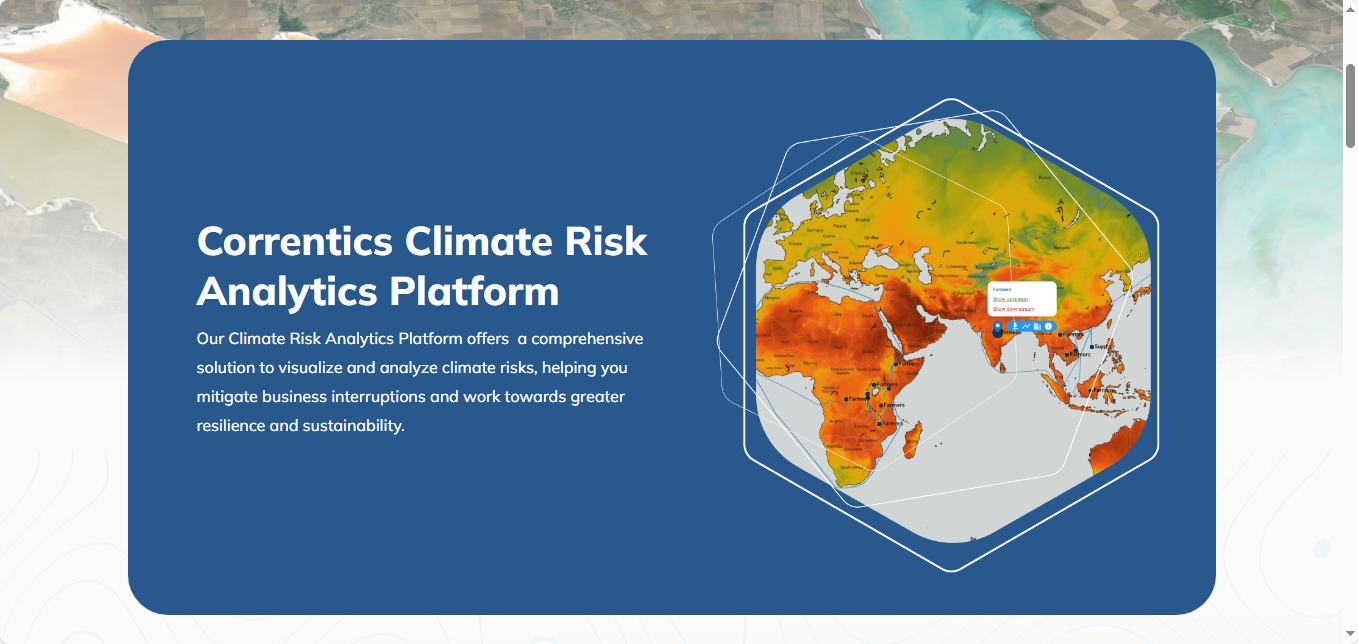
The Correntics platform focuses on forward-looking, physical climate risk assessment rather than historical emissions accounting. Its approach is to integrate climate science models, geospatial data, and proprietary analytics to project future climate impacts on a company's specific assets and supply chains. The platform’s capabilities include:
Value Chain Mapping: Visualize and analyze the climate vulnerabilities and interdependencies within a company's entire supply chain, identifying single points of failure.
Climate Scenario Assessment: Model the potential operational and financial impacts of different climate change projections on specific company assets and locations.
Disruption Monitoring: Track real-time and forecasted extreme weather events and other climate-related disruptions that could impact mapped supply chain nodes.
Trend Detection: Use analytics to identify long-term, emerging climate trends, such as shifting precipitation patterns or increasing heatwaves, that could affect strategic business plans.
Risk Communication: Generate clear reports and visualizations to communicate complex climate risks effectively to internal stakeholders, boards, and investors.
Mitigation Tracking: Monitor the implementation and effectiveness of adaptation and resilience strategies to ensure they align with broader sustainability and risk management goals.
Closing Insights
Correntics positions itself not just as a data provider but as a strategic resilience platform. Its key differentiator is a strong focus on the entire value chain, providing a holistic view of risk that extends beyond a company's four walls to its suppliers and logistics networks. This is critical for companies subject to emerging mandatory disclosure frameworks such as the EU's CSRD and TCFD which mandates detailed disclosure of physical climate risks and opportunities throughout a company's own operations and its value chain. The platform is also a practical tool for the construction and real estate sectors, helping projects meet new prerequisites like the Climate Resilience Assessment in LEED v5 building certification.
Companies might therefore want to consider Correntics if their primary concern is understanding and preparing for the physical impacts of climate change on their operations. The platform is designed to serve risk managers, supply chain directors, and sustainability officers who need to move from general awareness to specific, location-based action plans. While specific subscription fees are not listed publicly and are provided upon request, the platform emphasizes seamless data integration via spreadsheets and APIs. Correntics also offers expert advisory services and training to help clients interpret data and develop tailored resilience strategies, making it a tool for embedding climate risk into core business planning.