

Available Carbon Accounting Features
Missing Carbon Accounting Features
Pricing
Starting Price
Options
Available Since
Deployment Options
Good Option For
- Small Business (11-50 people)
- Medium Business (51-250 people)
- Large Business (250+ people)
Deep dive
Core Features
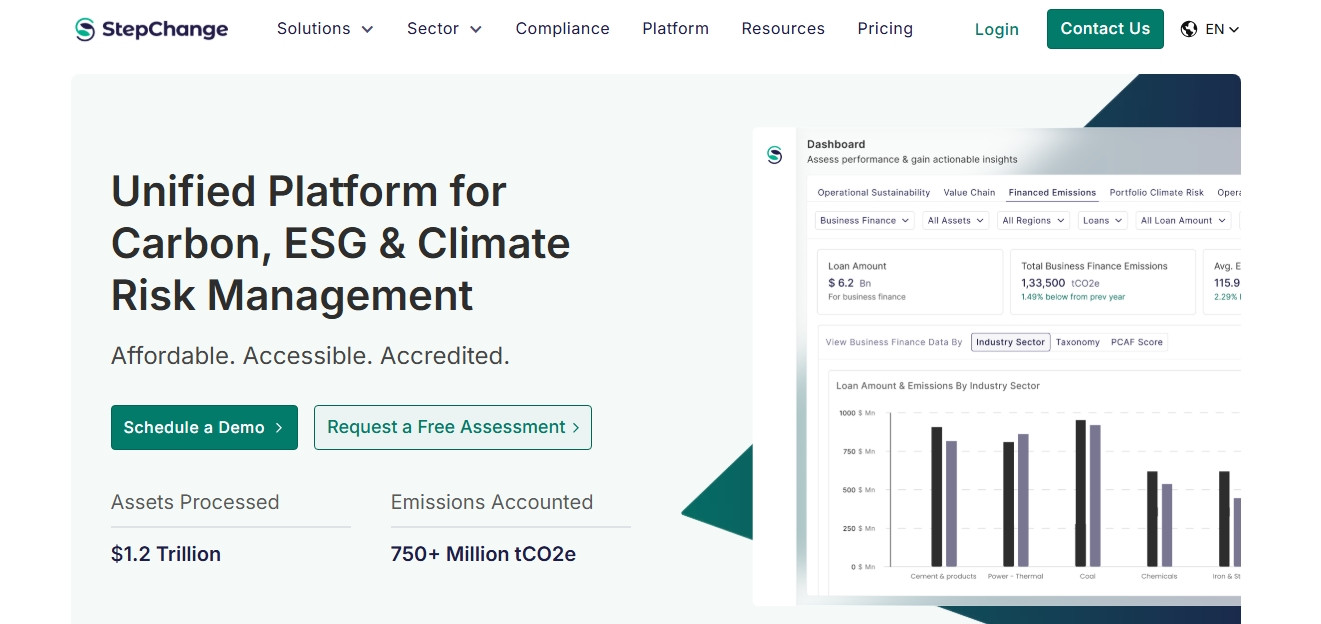
StepChange is built as an enterprise sustainability data platform rather than a standalone reporting tool. Its data, decision and disclosure engines are designed to connect emissions, ESG and climate-risk information with analytics, scenarios and workflow tools used by sustainability, risk and finance teams. Its features include:
Integrated data engine – Supports multi-modal data ingestion, alongside anomaly detection, rule-based validations, custom metrics, audit logs and access to the StepChange Data Registry.
Comprehensive carbon management – Covers Scope 1–2, Scope 3 categories 1–14 and financed emissions across all PCAF asset classes, with options for custom emission factors and avoided-emissions estimation.
ESG intelligence and scorecards – Provides operational ESG, value-chain ESG (via integrated supplier surveys) and portfolio ESG scorecards, tracking a broad set of environmental, social and governance indicators, supported by materiality assessments and survey workflows.
Climate and nature risk analytics – Quantifies physical and transition risks across operations, value chains and portfolios, using IPCC and NGFS scenarios alongside custom scenarios, and delivering metrics such as climate adaptation and transition scores.
Automated reporting and disclosure – Offers global disclosure templates and a report builder for major frameworks, supported by an AI reporting assistant, maker-checker workflows, assurance interface, and collaboration tools
Enterprise integrations and security – Connects with 350+ enterprise systems and popular business tools, underpinned by SOC 2 Type II, ISO 27001/27017, SSO, encryption and network-security controls.
Closing Insights
StepChange has been built at the intersection of climate science, finance and data engineering. Co-founder Ankit Jain is an IIT Bombay alumnus and MIT Sloan graduate, while co-founder and Chief Science Officer Dr Sidhant Pai holds both undergraduate and doctoral degrees from MIT in atmospheric and climate science. Their advisory bench currently includes Dr Jason Jay, Director of the MIT Sloan Sustainability Initiative, and Dr Erez Yoeli, who leads the Applied Cooperation Team at MIT. StepChange is also backed by investors such as Flourish Ventures and Beenext
On the market side, StepChange is used by banks and conglomerates such as State Bank of India, ICICI Bank, HDFC Bank and the Mahindra Group to manage carbon, ESG and climate risk. Its recognition as the first accredited PCAF regional partner in the Global South underlines its role in financed-emissions measurement for India’s financial sector. At the same time, India’s regulators are introducing green-deposit rules and climate-risk disclosure frameworks and preparing binding climate-risk reporting for banks later this decade, signaling a structural shift toward quantified financed emissions and portfolio-level climate governance. StepChange’s own publications highlight how RBI and SEBI expectations are pushing institutions to adopt robust carbon accounting and align portfolios with net-zero goals.
As similar regulations mature across developing markets, platforms like StepChange that connect financed-emissions accounting, climate-risk analytics and disclosure are positioned to become key tools in day-to-day sustainable finance operations.