
Available Circular Economy Features
Missing Circular Economy Features
Pricing
Starting Price
Options
Available Since
Deployment Options
Good Option For
- Small Business (11-50 people)
- Medium Business (51-250 people)
- Large Business (250+ people)
Deep dive
Core Features
Reath integrates financial, environmental, and logistical packaging data into a single source of truth. The platform's calculations are activity-based, deriving insights from specific material types, weights, recyclability, and the physical movement of reusable assets. This granular approach provides the precision needed for accurate fee calculations, carbon impact assessments, and operational optimization. This integrated system is delivered through several core capabilities:
Unified Packaging Intelligence: Centralize all packaging data—including materials, costs, carbon calculations, and recyclability—in one platform for complete oversight.
Automated Compliance Engine: Simplify complex EPR and Recycling Assessment Method (RAM) reporting by automatically calculating fees and generating compliance-ready reports in minutes.
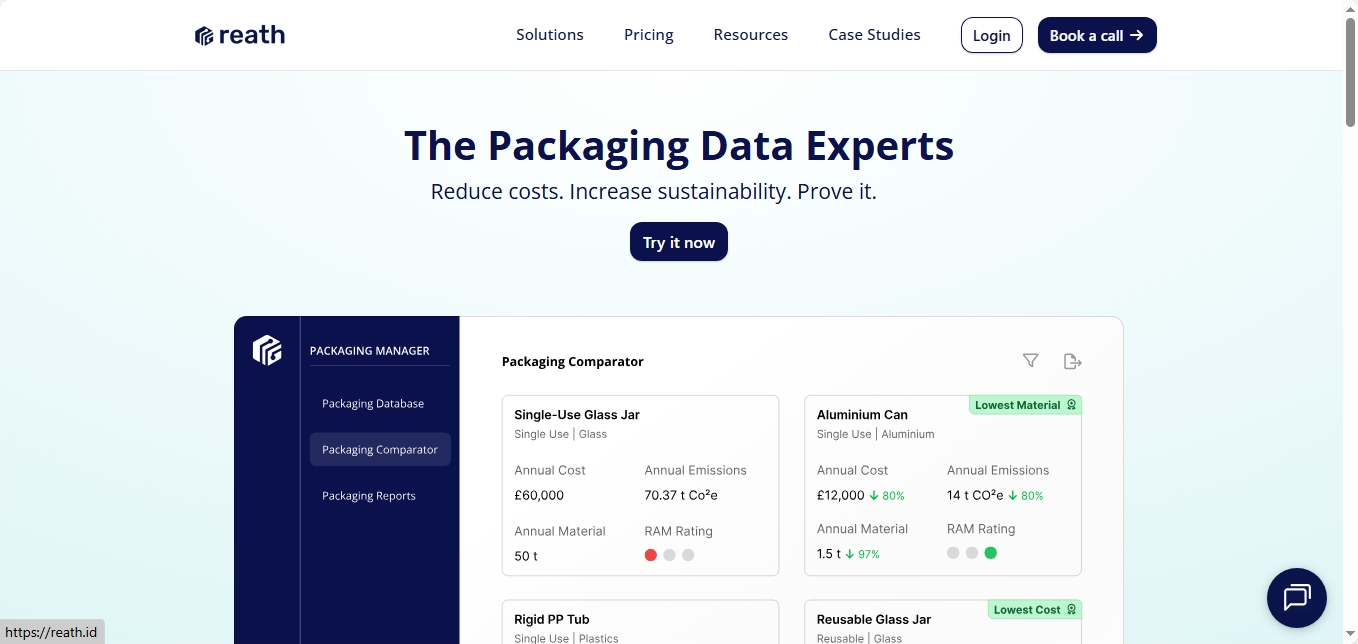
Comparative Scenario Modeling: Instantly compare the cost, carbon, and material use of different packaging options to build data-driven business cases for sustainable change.
Reusable Asset Tracking: Manage reusable packaging at scale with a track-and-trace system using QR, RFID, or NFC tags, monitored via an Android app.
Circular Performance Analytics: Monitor key reuse metrics like cycle times and return rates, forecast demand, and optimize operations to reduce loss and cut costs.
Digital Product Passports: Create compliance-ready digital identities for products to ensure transparency, share lifecycle data with consumers, and adhere to emerging EU legislation.
Closing Insights
Reath emerged in direct response to the global shift toward stricter packaging accountability, particularly the UK's Extended Producer Responsibility (EPR) scheme. This regulatory backdrop is not just a compliance hurdle but a core driver of the platform's design philosophy. Reath's founders identified that for businesses, the rising costs of single-use packaging (which could further increase due to EPR fees and plastics taxes) create a financial imperative to adopt reusables. The platform, therefore, is built to solve this dual challenge: managing the immediate burden of compliance while providing the tools to build a circular, cost-saving alternative.
This positions Reath as uniquely strategic for companies operating in the UK and the European Union, where EPR regulations are most advanced, and for businesses in parts of the United States, where similar EPR legislation for packaging is now being introduced. Its notable collaboration with UK waste management leader Biffa underscores its practical, sector-aligned approach. The platform’s key differentiation lies in its closed-loop focus; it doesn't just measure impact but provides the physical and digital infrastructure to create and manage reusable packaging systems, turning tracking data into a strategic asset.
For businesses, Reath offers a path from regulatory risk to circular opportunity. While specific subscription fees are not publicly listed, its value proposition is clear: automating compliance saves significant administrative hours and cost, while its analytical tools identify tangible reductions in both fees and material use. The platform’s integrations, including GS1-compliant tagging and API data feeds, are designed for enterprise-scale deployment. For brands seeking to mitigate regulatory risk, control packaging costs, and execute a genuine circular strategy, Reath is a strong option to consider.