New Catalyst Design Slashes Iridium Use in Green Hydrogen Production

Cut through the green tape
We don't push agendas. At Net Zero Compare, we cut through the hype and fear to deliver the straightforward facts you need for making informed decisions on green products and services. Whether motivated by compliance, customer demands, or a real passion for the environment, you’re welcome here. We provide reliable information. Why you seek it is not our concern.
The global shift toward renewable hydrogen is accelerating, but one of the industry’s persistent constraints remains the high cost and scarcity of iridium. Iridium is one of the rarest elements on Earth and is a critical component in proton exchange membrane electrolysers, which are widely used for producing green hydrogen from renewable electricity. As demand for hydrogen grows, so does pressure on iridium supplies, raising concerns about cost stability and the long-term scalability of electrolyser manufacturing.
Breakthrough Catalyst Architecture
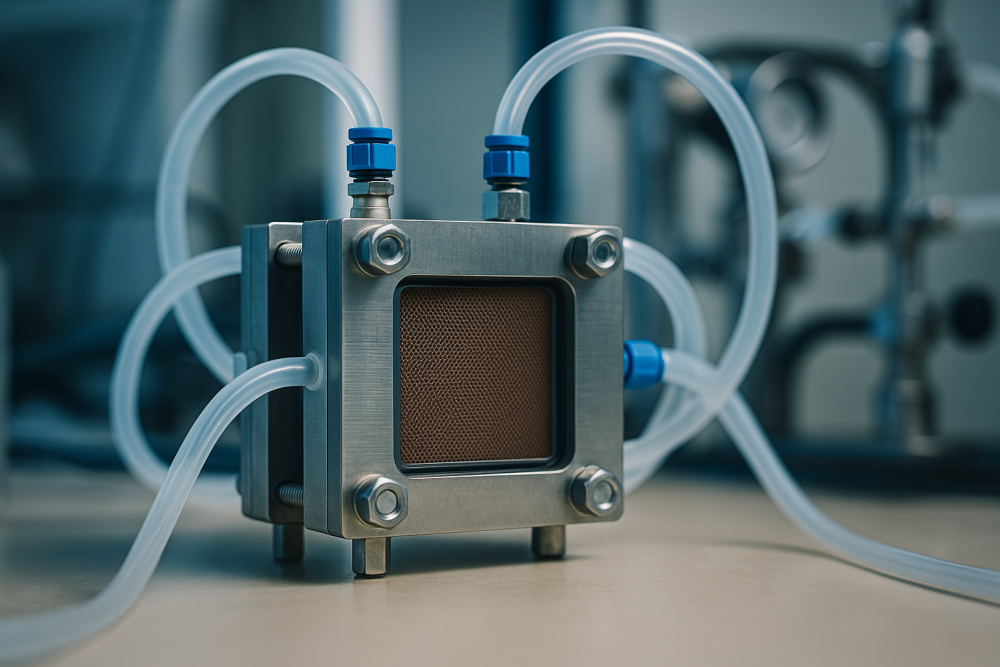
A new study reported by Interesting Engineering highlights a breakthrough catalyst architecture that significantly reduces the amount of iridium required for efficient water splitting. Developed by a research team investigating cost optimisations for green hydrogen systems, the innovation involves redesigning the catalyst layer to achieve higher performance with far less of the precious metal. If verified at scale, the approach could help remove a major bottleneck in the expansion of hydrogen technologies.
A More Efficient Use of Iridium
The promise of this development lies in how the redesigned catalyst distributes iridium. Conventional catalysts often deposit iridium in thick layers on support materials, which results in a large portion of the metal being inactive. The new method uses a structured support with vertically aligned channels that expose more iridium surface area to the electrochemical reaction. This makes it possible to reduce total iridium loading while maintaining or even improving catalytic activity.
Addressing Supply and Scalability Challenges
The researchers emphasise that more efficient use of iridium is essential for meeting global targets for electrolyser deployment. Current PEM electrolyser production already accounts for a significant portion of annual iridium demand, and large-scale net-zero scenarios call for rapid expansion of installed capacity in the 2030s and 2040s. Without breakthroughs in materials efficiency or alternative catalyst formulations, the industry risks running into supply bottlenecks that could slow investment or increase costs.
Durability and System Performance
Beyond material savings, the redesigned catalyst architecture also offers potential durability benefits. By preventing agglomeration and improving temperature and stress distribution across the catalyst layer, the structure could extend the operational lifetime of PEM systems. This is significant because the economics of green hydrogen production rely not only on capital costs but also on long-term reliability, particularly for industrial users who require high uptime and stable output.
Economic Implications for Green Hydrogen
Cost efficiency remains central to the competitiveness of green hydrogen. Electrolysers represent a major share of system investment, and catalyst materials contribute strongly to those costs. Reducing iridium intensity contributes directly to lowering capital expenditure, while stabilising material demand also supports healthier supply chains. If the new design can be manufactured at scale, it may help accelerate the cost declines necessary for hydrogen to compete with fossil-based alternatives in sectors such as steelmaking, fertiliser production, and heavy mobility.
Path Toward Commercial Deployment
The researchers note that the next steps involve scaling the fabrication method and testing it under real-world industrial conditions. Laboratory performance data provides an important foundation, but full commercial validation requires long-duration operation, integration with industrial stack designs, and compatibility assessments with existing PEM manufacturing processes. Companies across the hydrogen value chain are watching these developments closely, as incremental improvements in catalyst efficiency can have system-wide impacts when deployed globally.
Strategic Importance for Hydrogen Policy
The breakthrough arrives at a time when governments and industry are strengthening their hydrogen strategies. The European Union, the United States, and several Asian economies have all identified PEM electrolysers as a key technology for decarbonising sectors that cannot be electrified directly. Reducing dependence on iridium supports these strategies by mitigating resource risk and improving resilience in future supply chains.
Outlook
If commercialised, the new catalyst design could play an important role in scaling green hydrogen production more sustainably and cost-effectively. It represents a practical advance aligned with the broader objective of developing technologies that balance performance, durability, and material efficiency. For industries preparing to integrate green hydrogen into long-term decarbonisation plans, innovations such as this may help build confidence that supply challenges can be resolved through targeted scientific and engineering progress.
Source: interestingengineering.com

Mentioned in this article...
More related content

OMV Warns Rigid Recycling Rules May Slow Plastics Innovation

Wind and Solar Overtake Fossil Fuels in EU Power Generation
OpenAI Outlines Strategy to Control Rising Data Centre Energy Costs