Kawasaki Signs Deal to Build World’s Largest Liquefied Hydrogen Carrier

Cut through the green tape
We don't push agendas. At Net Zero Compare, we cut through the hype and fear to deliver the straightforward facts you need for making informed decisions on green products and services. Whether motivated by compliance, customer demands, or a real passion for the environment, you’re welcome here. We provide reliable information. Why you seek it is not our concern.
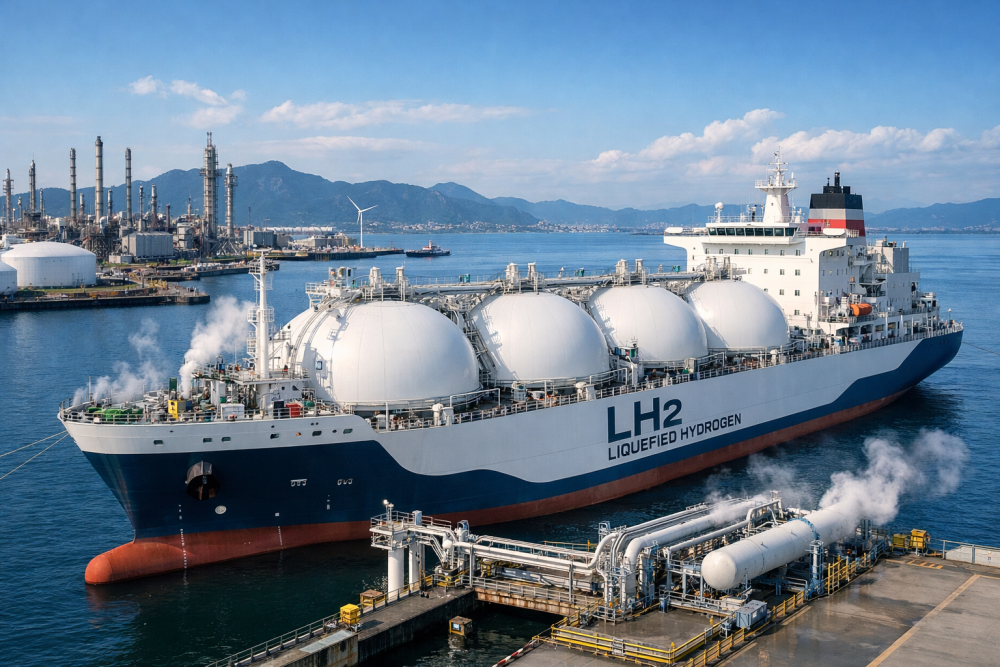
Kawasaki Heavy Industries has signed a deal to build the world’s largest liquefied hydrogen carrier, according to a report by Reuters. The vessel is intended to transport hydrogen in liquid form at a commercial scale, a key step in the development of international hydrogen supply chains aimed at supporting decarbonisation across energy-intensive sectors.
The agreement reflects growing interest in hydrogen as a low-carbon energy carrier, particularly among countries that expect to rely on imports to meet climate targets. By moving beyond pilot-scale vessels, the project signals a shift toward early commercialisation of hydrogen shipping infrastructure.
Advanced Cryogenic Technology
Liquefied hydrogen must be stored and transported at around minus 253 ºC, far colder than liquefied natural gas. This requires highly specialised cryogenic tanks, insulation systems, and safety measures to prevent boil-off and manage hydrogen’s physical properties.
Kawasaki has been developing hydrogen transport technology for several years. It previously built the Suiso Frontier, a small demonstration vessel launched in 2019 that carried liquefied hydrogen between Australia and Japan as part of a government-backed pilot project. The new carrier will be significantly larger, designed to improve transport efficiency and reduce per-unit shipping costs.
Role in National Hydrogen Strategies
Japan has positioned hydrogen as a central element of its long-term energy transition strategy. With limited domestic renewable resources, the country sees imported hydrogen as a way to decarbonise power generation, industry, and parts of the transport sector while maintaining energy security.
Australia has emerged as an early partner in hydrogen pilot projects, due to its renewable energy potential and proximity to Japan. Other regions, including the Middle East and North America, are also being considered as potential future suppliers. Large-scale hydrogen carriers are seen as essential to making these international supply chains viable.
Infrastructure and Port Implications
The development of large liquefied hydrogen carriers has implications well beyond shipbuilding. Ports will need new infrastructure, including dedicated storage tanks, loading arms, safety zones, and monitoring systems designed specifically for hydrogen.
Crews and port operators will also require specialised training, as hydrogen presents different risks compared with conventional fuels. Classification societies and regulators are working to establish technical standards and safety frameworks, but many aspects of hydrogen shipping remain under development.
Climate Impact and Production Pathways
The climate benefits of hydrogen transport depend heavily on how the hydrogen is produced. Hydrogen made using renewable electricity through electrolysis offers the lowest lifecycle emissions, but remains more expensive than conventional production methods and accounts for a small share of global output.
Hydrogen produced from natural gas with carbon capture can reduce emissions compared to unabated fossil fuels, but its net climate impact depends on capture efficiency and upstream methane emissions. As a result, the expansion of hydrogen shipping alone does not guarantee emissions reductions without parallel progress in clean hydrogen production.
Cost and Competition with Other Carriers
Transporting hydrogen in liquefied form is energy-intensive and costly. Even with larger vessels, shipping liquefied hydrogen is expected to be more expensive on an energy-equivalent basis than LNG. Alternative approaches, such as converting hydrogen into ammonia or other chemical carriers that are easier to transport, are also being actively explored.
Each option involves trade-offs in efficiency, cost, safety, and end-use flexibility. The success of liquefied hydrogen shipping will depend on whether these challenges can be managed at scale and whether demand materialises from industrial and power sector users.
Strategic Importance for Industry
For Kawasaki, the project aligns with a broader strategy to focus on hydrogen and other low-carbon technologies as future growth areas. Delivering a commercial-scale hydrogen carrier could strengthen the company’s position in a market that is still emerging but expected to grow as climate policies tighten.
Industry observers note that large hydrogen carriers are a necessary, though not sufficient, condition for the development of global hydrogen trade. Without proven transport solutions, investment in production facilities and downstream hydrogen use is likely to remain cautious.
Outlook for Global Hydrogen Trade
While details on timelines and commercial partners have not been fully disclosed, the deal underscores increasing momentum behind hydrogen infrastructure development. Governments and companies are moving from feasibility studies toward tangible assets that could underpin future clean energy markets.
If Kawasaki’s carrier demonstrates that liquefied hydrogen can be transported safely and economically at scale, it could help accelerate international hydrogen trade and support wider net-zero transition efforts. At the same time, its progress will highlight whether liquefied hydrogen can compete with alternative transport pathways in the race to decarbonise global energy systems.
Source: www.reuters.com

Mentioned in this article...
Organizations
Glossary terms
More related content

OMV Warns Rigid Recycling Rules May Slow Plastics Innovation
Wind and Solar Overtake Fossil Fuels in EU Power Generation
OpenAI Outlines Strategy to Control Rising Data Centre Energy Costs