Industrial Clusters are Emerging as Key Engines of the Circular Economy

Cut through the green tape
We don't push agendas. At Net Zero Compare, we cut through the hype and fear to deliver the straightforward facts you need for making informed decisions on green products and services. Whether motivated by compliance, customer demands, or a real passion for the environment, you’re welcome here. We provide reliable information. Why you seek it is not our concern.
Industrial clusters are gaining prominence as one of the most effective mechanisms for translating circular economy concepts into measurable environmental and economic outcomes. According to recent analysis published by the World Economic Forum, geographically concentrated networks of companies, utilities, and service providers are uniquely positioned to close material loops, reduce emissions, and improve industrial resilience.
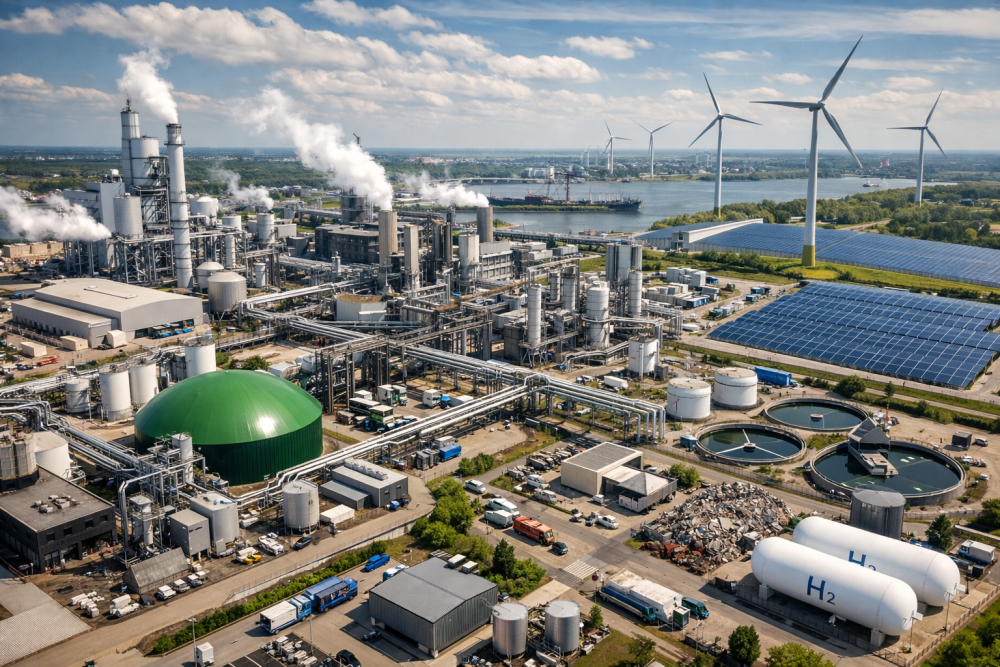
Unlike isolated corporate sustainability initiatives, industrial clusters enable multiple companies to share resources such as energy, water, heat, logistics, and waste processing infrastructure. This collective approach allows firms to surpass incremental efficiency gains and implement systemic circular solutions that would be uneconomical or technically infeasible on a standalone basis.
Industrial Symbiosis and Shared Resource Use
At the core of the cluster-based circular economy is industrial symbiosis. Waste streams, by-products, and excess heat from one facility can become valuable inputs for another. Residual heat from steel or cement plants can be reused in district heating systems or adjacent manufacturing processes. Organic waste can be converted into biogas for local energy generation, while captured CO₂ can be reused in chemicals, construction materials, or synthetic fuels.
By enabling these exchanges at scale, clusters reduce raw material demand, cut waste disposal costs, and significantly lower lifecycle emissions. The physical proximity of facilities simplifies logistics and allows infrastructure to be designed from the outset for reuse, recovery, and flexibility.
Decarbonising Heavy Industry Through Collaboration
Heavy industry accounts for roughly a quarter of global greenhouse gas emissions, with sectors such as steel, cement, chemicals, and refining facing limited short-term decarbonisation options. Industrial clusters offer a practical pathway to deploy shared low-carbon solutions, including carbon capture and storage, hydrogen production and distribution, electrification, and advanced recycling systems.
Pooling demand across multiple companies lowers investment risk and improves the economics of capital-intensive technologies. Shared pipelines, storage facilities, and energy hubs reduce duplication and accelerate deployment timelines, helping industries move faster toward climate targets while maintaining competitiveness.
Policy Frameworks Enabling Cluster Development
Policy alignment is a critical enabler of successful industrial clusters. Governments in Europe, Asia, and the Americas are increasingly integrating industrial policy, climate regulation, and infrastructure investment to support cluster-based approaches. This includes public funding for shared assets, streamlined permitting processes, and regulatory frameworks that recognise collective emissions reductions.
In some regions, policymakers are exploring cluster-level emissions accounting to complement traditional company-based reporting. This approach reflects the reality of shared systems and could provide stronger incentives for collaboration while maintaining transparency and accountability.
The Role of Digitalisation and Data Sharing
Digital tools are playing a growing role in unlocking circular economy opportunities within industrial clusters. Data-sharing platforms allow participants to map material and energy flows, identify synergies, and optimise resource use in real time. Advanced analytics and artificial intelligence support predictive maintenance, waste forecasting, and energy balancing across complex systems.
These capabilities are particularly valuable in large clusters with diverse industrial activities, where manual coordination would be impractical. Digitalisation also supports compliance reporting and performance tracking, which are increasingly important for regulators and investors.
Governance, Financing, and Workforce Challenges
Despite their potential, industrial clusters face several challenges. Governance is a key issue, as clusters often involve competitors with different commercial interests and risk profiles. Clear contractual arrangements, neutral coordinating bodies, and transparent data governance frameworks are essential to build trust and ensure fair cost and benefit sharing.
Financing shared infrastructure can also be complex, particularly when assets do not align neatly with traditional project finance models. Blended finance, public guarantees, and long-term offtake agreements are emerging as important tools to unlock investment.
Workforce skills are another critical factor. Circular industrial systems require expertise in systems integration, digital technologies, and cross-company collaboration. At the same time, clusters can support a just transition by anchoring industrial employment locally and fostering regional innovation ecosystems.
Strategic Implications for Industry and Policymakers
From a business perspective, participation in industrial clusters is increasingly viewed as a strategic necessity rather than a sustainability add-on. Companies face growing pressure from regulators, investors, and customers to demonstrate credible and cost-effective decarbonisation pathways. Cluster-based solutions can reduce compliance risk, improve supply chain resilience, and enhance long-term competitiveness.
For policymakers, the challenge lies in scaling successful pilot projects into fully integrated, replicable cluster systems. As climate targets tighten and resource constraints intensify, industrial clusters offer a pragmatic route to embed circular economy principles at scale while supporting economic growth and industrial
Source: www.weforum.org

Mentioned in this article...
More related content

OMV Warns Rigid Recycling Rules May Slow Plastics Innovation
Wind and Solar Overtake Fossil Fuels in EU Power Generation
OpenAI Outlines Strategy to Control Rising Data Centre Energy Costs