How Jabil Is Uncovering Sustainability Across Global Operations

Cut through the green tape
We don't push agendas. At Net Zero Compare, we cut through the hype and fear to deliver the straightforward facts you need for making informed decisions on green products and services. Whether motivated by compliance, customer demands, or a real passion for the environment, you’re welcome here. We provide reliable information. Why you seek it is not our concern.
For global manufacturers, sustainability has shifted from a reporting obligation to a core operational challenge. Managing emissions across dozens of countries, hundreds of facilities, and thousands of suppliers requires more than high-level targets. It demands detailed, reliable data that can inform everyday decisions.
Jabil, a multinational manufacturing services provider operating in more than 30 countries, is addressing this challenge by embedding sustainability data into the way it runs its business. Serving industries ranging from electronics and healthcare to automotive, industrial equipment, and energy, Jabil faces highly varied emissions profiles and regulatory environments across its global footprint.
This diversity creates complexity, but it also offers an opportunity. By standardising how sustainability data is collected and analysed, Jabil aims to uncover patterns, risks, and opportunities that would otherwise remain obscured at the site level.
Data as the Foundation of Decarbonisation
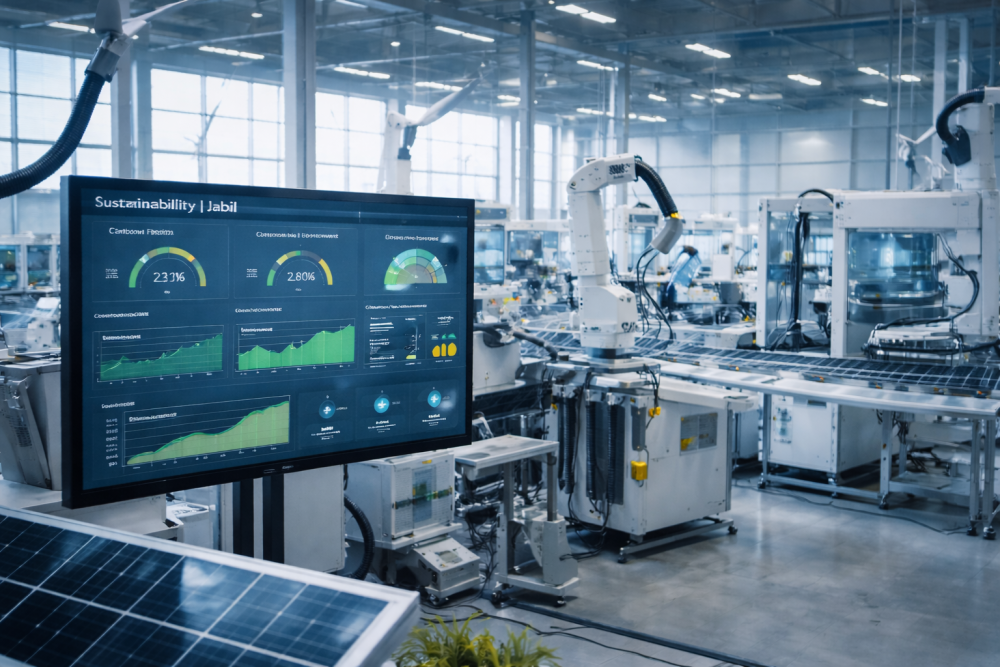
At the centre of Jabil’s sustainability strategy is a focus on improving data quality and accessibility. Rather than treating sustainability reporting as a standalone exercise, the company integrates environmental data into its core operational systems.
Advanced digital platforms allow Jabil to consolidate emissions and energy data from across its facilities. This enables more accurate tracking of Scope 1 and Scope 2 emissions, while also improving visibility into Scope 3 emissions across its supply chain. For a large manufacturing organisation, this level of granularity is essential to prioritise actions that deliver measurable emissions reductions.
Reliable data also supports internal accountability. Facility managers can compare performance across sites, identify inefficiencies, and understand how operational changes affect energy use and emissions over time.
Managing Energy Use Across Manufacturing Sites
Energy consumption represents one of the largest sources of emissions for Jabil’s operations. Manufacturing facilities often operate around the clock and rely on energy-intensive processes, particularly in electronics manufacturing and precision engineering.
By using real-time and near-real-time energy monitoring, Jabil can better understand how energy is consumed across different production lines and locations. This insight supports targeted efficiency measures, including equipment upgrades, process optimisation, and improvements to building management systems.
In parallel, Jabil is increasing its use of renewable electricity through mechanisms such as power purchase agreements and on-site generation where viable. Access to detailed energy data helps determine where renewable energy investments can deliver the greatest emissions and cost benefits, taking into account local grid intensity, energy prices, and regulatory conditions.
Extending Sustainability Into the Supply Chain
Like many global manufacturers, Jabil recognises that the majority of its carbon footprint lies beyond its own facilities. Scope 3 emissions associated with purchased materials, components, logistics, and services often account for the largest share of total emissions, yet they are also the most difficult to measure and influence.
To address this, Jabil is working to improve supplier engagement and data transparency. By standardising how suppliers report environmental data, the company can benchmark performance and identify areas where collaboration can drive emissions reductions.
Digital tools play a critical role in this process. Consistent data collection allows Jabil to engage suppliers with clearer expectations, while also supporting customers that require robust Scope 3 reporting as part of their own sustainability commitments.
Responding to Regulatory and Investor Pressure
The push for improved sustainability data is also being driven by external pressures. Regulatory frameworks in major markets are introducing stricter disclosure requirements, increasing the need for accurate, auditable emissions data. At the same time, investors and customers are demanding greater transparency around climate risks and decarbonisation strategies.
For Jabil, strengthening sustainability data systems supports compliance while reducing exposure to regulatory, financial, and reputational risks. Understanding where emissions and energy risks are concentrated enables more informed capital allocation and long-term planning.
This approach reflects a broader shift across the industry, where sustainability, risk management, and financial performance are becoming increasingly interconnected.
Sustainability as an Evolving Operational Capability
Jabil positions sustainability not as a fixed destination, but as an evolving operational capability. Manufacturing technologies, policy frameworks, and customer expectations continue to change, requiring systems that can adapt over time.
By embedding sustainability data into decision-making processes, the company aims to remain flexible as net-zero pathways become clearer and more demanding. This includes the ability to reassess targets, adjust investment priorities, and respond to new regulatory or market signals.
Lessons for Global Manufacturers
Jabil’s experience offers practical insights for other industrial organisations navigating the net-zero transition. Large, complex operations can make meaningful progress by focusing on data visibility, aligning digital tools with operational priorities, and engaging suppliers early in the process.
While data alone does not reduce emissions, it enables the clarity and precision required to act at scale. As net-zero commitments accelerate across manufacturing and technology sectors, the ability to uncover sustainability performance across operations is likely to become a defining factor in long-term competitiveness.
Source: sustainabilitymag.com

Mentioned in this article...
Organizations
More related content

OMV Warns Rigid Recycling Rules May Slow Plastics Innovation
Wind and Solar Overtake Fossil Fuels in EU Power Generation
OpenAI Outlines Strategy to Control Rising Data Centre Energy Costs