EU Weighs Fast-Track Rules for AI Gigafactories Amid Environmental Concerns

Cut through the green tape
We don't push agendas. At Net Zero Compare, we cut through the hype and fear to deliver the straightforward facts you need for making informed decisions on green products and services. Whether motivated by compliance, customer demands, or a real passion for the environment, you’re welcome here. We provide reliable information. Why you seek it is not our concern.
The European Union is considering exempting large-scale artificial intelligence computing facilities, often referred to as AI gigafactories, from standard environmental impact assessments. The proposal forms part of a wider policy effort to accelerate the deployment of strategic digital infrastructure and strengthen Europe’s position in global AI development.
According to reporting by The Guardian, the initiative is being developed by the European Commission as part of its broader industrial and digital competitiveness agenda. Officials argue that existing permitting and assessment procedures are too slow to match the pace of AI investment taking place in other major economies, particularly the United States and China.
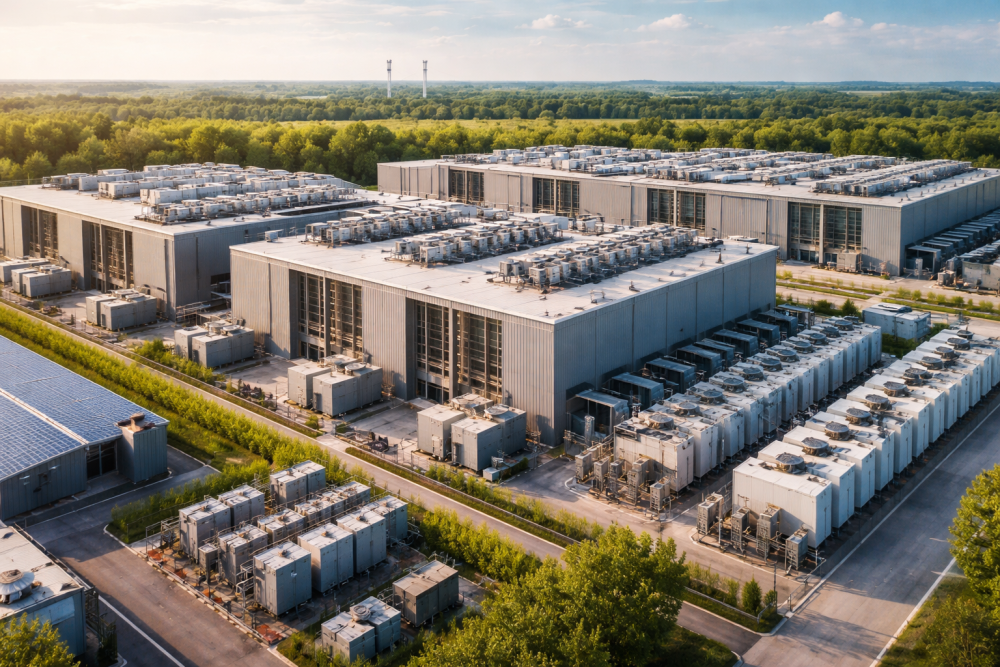
AI gigafactories are large computing facilities designed to train and operate advanced AI models. They typically house thousands of high-performance processors and require substantial electricity and cooling capacity. In energy terms, a single facility can consume as much power as a small city, making them a significant consideration for energy planning and climate policy.
Current Environmental Assessment Rules
Under existing EU law, infrastructure projects of this scale are usually subject to environmental impact assessments. These assessments examine potential effects on greenhouse gas emissions, electricity demand, water use, land take, biodiversity and local communities before construction approvals are granted.
Environmental impact assessments also play a governance role by ensuring transparency and enabling public consultation. Local authorities and residents can raise concerns related to grid capacity, water availability, transport impacts and cumulative environmental pressures.
The proposed exemption would allow AI gigafactories to bypass or significantly simplify these assessments if they are classified as projects of strategic European interest. Supporters say this would reduce administrative delays and create greater certainty for investors.
Rationale Behind the Exemption
The Commission’s rationale is rooted in concerns about Europe falling behind in AI infrastructure. Advanced AI systems require vast computing resources, and access to domestic capacity is increasingly viewed as a matter of economic resilience and technological sovereignty.
Officials have indicated that environmental safeguards would not be removed entirely, but integrated into alternative regulatory mechanisms. These could include sustainability criteria linked to public funding, energy efficiency standards, or operational reporting requirements rather than full assessments at the planning stage.
The proposal aligns with recent EU policy approaches in other strategic sectors, such as semiconductors and clean hydrogen, where faster permitting has been prioritised to support industrial-scale deployment.
Climate and Energy Implications
The prospect of exempting AI gigafactories from environmental assessments has raised concerns among climate and environmental groups. Data centres already represent a growing share of electricity demand across Europe, and AI workloads are expected to accelerate this trend.
The International Energy Agency has warned that global data centre electricity consumption could double by 2030, driven largely by AI applications. In countries with constrained grids, including parts of Ireland, Germany and the Netherlands, data centre growth has already prompted policy interventions.
From a net-zero perspective, critics argue that fast-tracking large energy-intensive facilities risks locking in fossil fuel generation if renewable capacity and grid upgrades do not keep pace. The EU has legally binding targets to cut greenhouse gas emissions by at least 55% by 2030 and reach climate neutrality by 2050, making the management of new electricity demand a central policy challenge.
Water use is another concern. Many data centres rely on water-based cooling systems, which can place additional pressure on local water resources, particularly during heatwaves and droughts that are becoming more frequent due to climate change.
Governance and Local Authority Concerns
Local and regional authorities have expressed unease about the potential loss of oversight. Environmental impact assessments are often the main mechanism through which municipalities assess whether large projects are compatible with local infrastructure, housing plans and environmental conditions.
Removing or weakening these assessments could limit local input and increase the risk of public opposition after construction has begun. Previous disputes over data centre development in several EU member states have highlighted the importance of early engagement and transparent decision-making.
Legal experts have also noted that exemptions from environmental law could face challenges if they are perceived to undermine existing EU environmental protections.
Industry Perspective and Mitigation Options
Industry stakeholders argue that AI gigafactories are not inherently incompatible with climate goals. Developers point to improvements in energy efficiency, advanced cooling technologies and the growing use of renewable power purchase agreements.
Some technology companies have committed to operating data centres on 24-hour carbon-free electricity, although implementation varies by region and depends on grid conditions. Locating facilities near renewable generation, nuclear power or industrial waste heat sources is also seen as a way to reduce environmental impacts.
The Commission has suggested that operational sustainability requirements could replace pre-construction assessments, shifting oversight towards continuous monitoring of energy use and emissions.
Next Steps and Policy Debate
The proposal is expected to be debated by the European Parliament and EU member states in the coming months. Negotiations are likely to focus on defining what qualifies as an AI gigafactory, what safeguards would apply, and how environmental and climate objectives can be maintained alongside industrial acceleration.
For investors, the outcome could significantly affect project timelines and site selection across Europe. For policymakers, it highlights the growing tension between digital competitiveness and environmental governance in an economy increasingly shaped by energy-intensive technologies.
Source: www.theguardian.com

Mentioned in this article...
Organizations
More related content

OMV Warns Rigid Recycling Rules May Slow Plastics Innovation
Wind and Solar Overtake Fossil Fuels in EU Power Generation
OpenAI Outlines Strategy to Control Rising Data Centre Energy Costs