

Available ESG Monitoring Features
Missing ESG Monitoring Features
Pricing
Starting Price
Options
Available Since
Deployment Options
Good Option For
- Medium Business (51-250 people)
- Large Business (250+ people)
Deep dive
Core Features
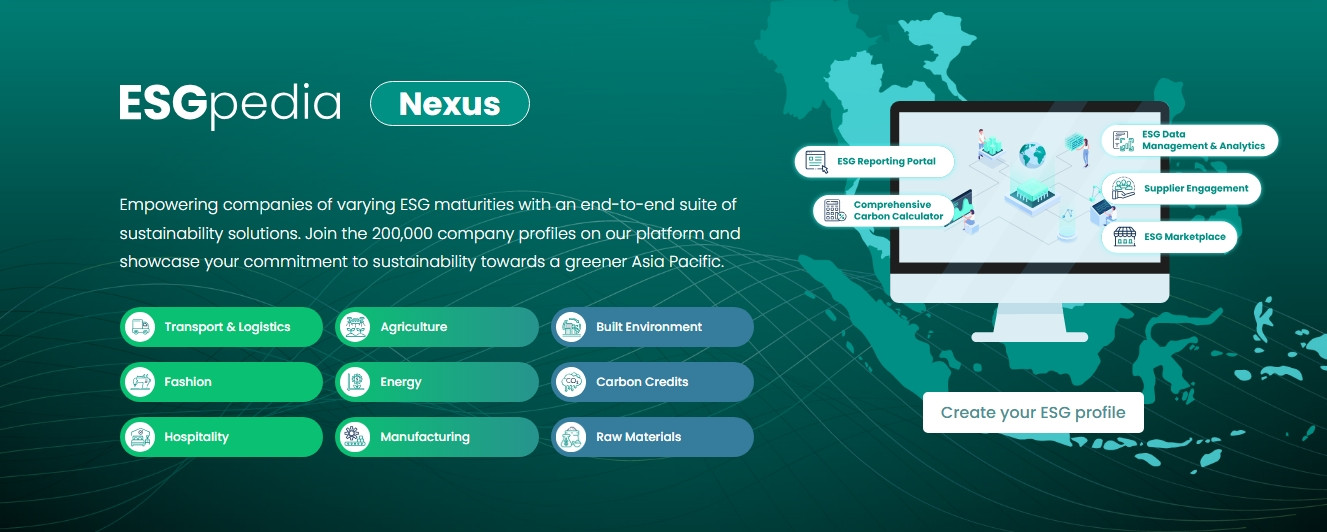
ESGpedia aggregates and normalizes multi-source ESG information, preserves provenance (via registry and blockchain origins), and packages workflows enabling non-specialists to produce compliant reports. Its key capabilities include:
Standards-Aligned Reporting — Generate ready-to-publish reports mapped to international and local rules to streamline compliance workloads.
GHG Emissions Calculator — In-platform calculator (aligned with global standards) to convert operational data into Scopes 1–3 estimates for corporates and suppliers.
Verified Data Registry — Aggregates certifications and ESG data from trusted sources with recorded provenance, originally built to power MAS Greenprint’s ESG Registry.
Supply-Chain Enablement — Tooling and industry factors to help SMEs/sub-contractors enter data and quantify embodied emissions for downstream reporting.
AI-Supported Data Harmonisation — Nexus/Intelligence modules to aggregate, standardize and surface ESG insights for businesses and financiers in APAC.
Ecosystem & Marketplace — Distribution via public initiatives (e.g., ESBN/SAFE) and availability on AWS Marketplace for scalable procurement and onboarding.
Closing Insights
Launched in May 2022 as a verified ESG data registry, ESGpedia was built to close information gaps that hinder sustainable finance through provenance-tracked, shareable data. It has since evolved into Nexus for corporate workflows and Intelligence for data consolidation and analytics, enabling organisations to meet fast-changing disclosure rules across Europe and Asia. Companies like Durapower Group and major construction firms in Singapore use ESGpedia for Scope 1–3 calculations, supplier engagement, and project-level reporting. Broader deployments include MAS Project Greenprint, UN-ESCAP ESBN/SAFE, and CO2X (Connect), all leveraging ESGpedia’s common data layer. Recent advances (AWS Marketplace listing, Databricks Validated Partner status, and collaboration with Singapore Polytechnic) extend its scale, engineering depth, and regional skills base. By uniting verified ESG data, calculators, and multi-framework templates in one connected ecosystem, ESGpedia gives organizations a practical path to transparent, finance-grade sustainability reporting across the APAC region and beyond.