

Available Supply Chain Sustainability Features
Missing Supply Chain Sustainability Features
Pricing
Starting Price
Options
- Annual Subscription
Available Since
Deployment Options
Good Option For
- Small Business (11-50 people)
- Medium Business (51-250 people)
- Large Business (250+ people)
Deep dive
Core Features
Climate Essentials for Supply Chain is positioned as a supplier-engagement and data platform rather than a generic carbon calculator. It builds on the Climate Essentials for Business workspace that suppliers use for their own operational footprints, then connects that information back to buyers through a dedicated interface. The emphasis is on primary data, standardised templates and clear visuals so organisations can move beyond high-level spend estimates and start managing real supplier performance over time. Against that background, some of its main capabilities are:
Supplier invitations and co-branding – Buying organisations can invite suppliers to join a co-branded carbon management platform, using their own logo to reinforce programme identity while suppliers access Climate Essentials for Business to measure their operational emissions.
Primary emissions data capture – Suppliers are asked to enter data across defined categories (Scope 1, Scope 2, freight, purchased goods and services, waste), ensuring the supply-chain module works with consistent, activity-based information.
Automated Scope 3 calculations – The module clarifies supply-chain Scope 3 emissions, using supplier submissions and buyer expenditure data so that dashboards reflect a more accurate view of the value-chain footprint.
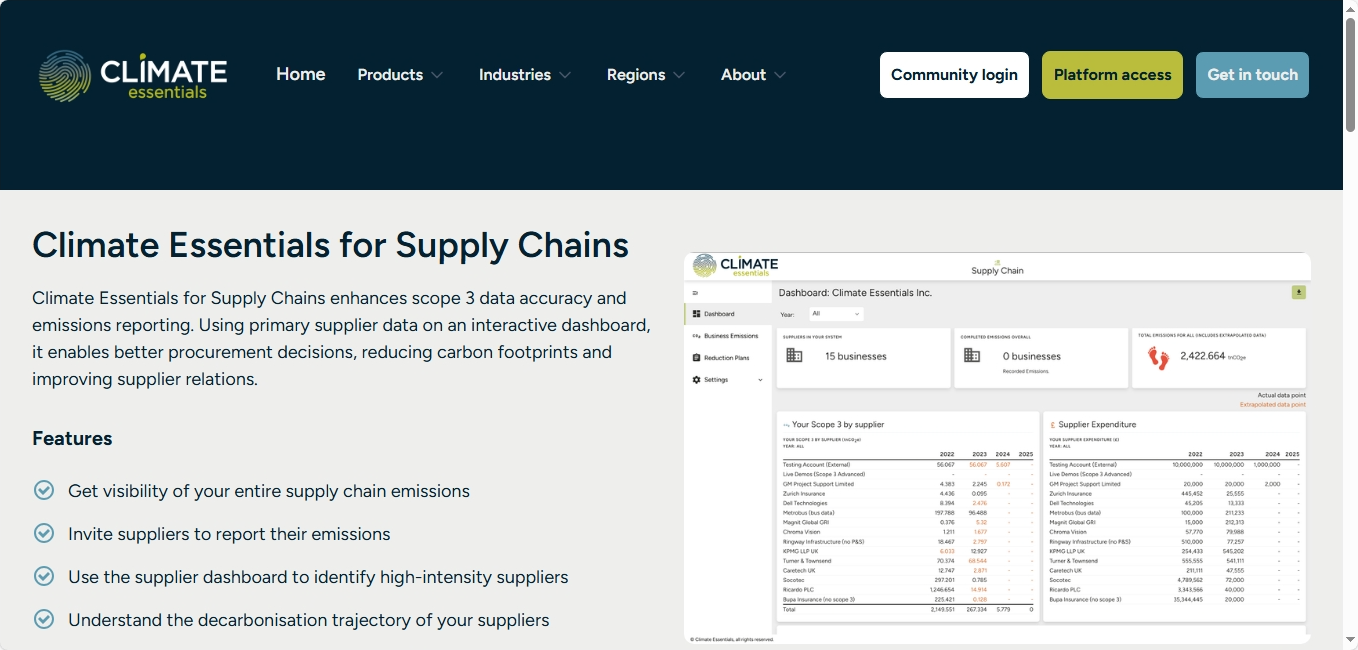
Buyer dashboard and analytics – Climate Essentials for Supply Chain provides an interactive buyer dashboard showing supplier contributions to Scope 3, emissions by sector, highest contributors and detailed supplier profiles.
Scalability and multi-user access – Buyers can add an unlimited number of suppliers and an unlimited number of buyer-side users to the management dashboard, supporting large or complex procurement portfolios without per-supplier limits.
Programme support and resources – Supply-chain licences include a programme manager as standard and access to onboarding materials, tutorials and the wider Net Zero Community resources.
Closing Insights
Supply-chain emissions often represent the largest portion of a company’s carbon footprint and are the hardest to quantify. Climate Essentials identifies this challenge and offers Supply Chain as a scalable, data-driven solution. By replacing spend-based estimates with supplier-provided data, the module helps firms get a clearer, more accurate picture of upstream emissions, revealing hot-spots and enabling strategic supplier engagement rather than one-time questionnaires.
The buyer-side dashboard and analytics make it easier for procurement and sustainability teams to integrate carbon data into procurement decisions, supplier scorecards and reduction strategies, potentially improving supplier relations, transparency and long-term resilience. For users concerned about data consistency and auditability, the Climate Essentials model bundles software with support and community resources, offering a middle ground between spreadsheets and full consultancy services.
For organisations eager to move beyond coarse estimates toward actionable supply-chain carbon management and to track performance across many suppliers over time, Climate Essentials for Supply Chain provides a structured, scalable platform to support those goals.