China’s Power Market Reforms and Data Centre Expansion Drive a New Battery Storage Boom

Cut through the green tape
We don't push agendas. At Net Zero Compare, we cut through the hype and fear to deliver the straightforward facts you need for making informed decisions on green products and services. Whether motivated by compliance, customer demands, or a real passion for the environment, you’re welcome here. We provide reliable information. Why you seek it is not our concern.
China is reshaping its electricity sector through a gradual shift toward more market-based pricing. Historically, much of the country’s power supply was governed by long-term contracts and regulated tariffs, offering limited price variation. Recent reforms, however, are expanding spot power markets across multiple provinces, allowing electricity prices to fluctuate in response to real-time supply and demand.
These changes are intended to improve efficiency, encourage competition, and enable higher integration of renewable energy. At the same time, they introduce greater price volatility, particularly during periods of peak demand or low renewable output. This volatility is becoming a defining feature of China’s evolving power system and is influencing how large electricity consumers manage their energy needs.
Data Centres Drive Rapid Growth in Electricity Demand
China’s data centre sector is expanding rapidly, fuelled by cloud computing, artificial intelligence, and digital services. Large-scale facilities are being developed across multiple regions as companies race to build computing capacity to support economic growth and technological innovation.
Data centres are among the most energy-intensive commercial users of electricity. They require constant, high-quality power and have limited tolerance for outages or fluctuations. As power prices become more variable under market reforms, data centre operators face rising exposure to cost uncertainty and supply risks.
In parallel, regulators and investors are placing increasing emphasis on the environmental footprint of digital infrastructure. Data centres are under growing pressure to demonstrate alignment with national energy efficiency and emissions reduction goals.
Battery Storage Emerges as a Strategic Solution
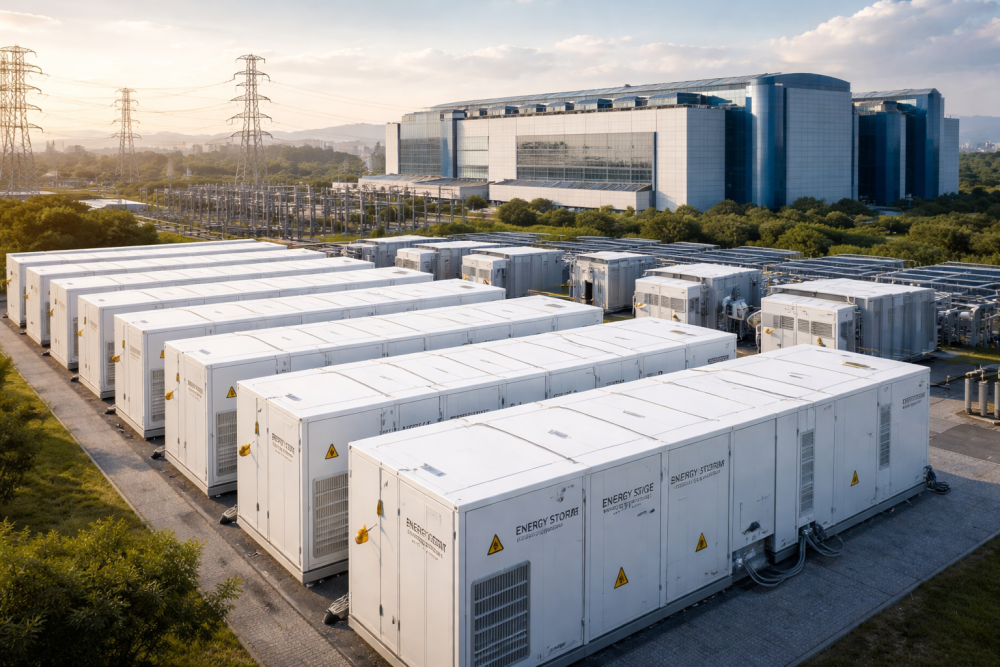
Battery energy storage is becoming a central tool for data centre operators seeking to manage both cost and reliability risks. By charging batteries when electricity prices are low and discharging during peak periods, operators can reduce exposure to volatile spot prices.
Storage systems also provide backup power and grid support, helping data centres maintain continuous operations during outages or grid stress events. In regions with high renewable penetration, batteries can smooth intermittent supply and improve power quality, which is critical for sensitive digital equipment.
As battery costs have fallen, storage is increasingly viable not only for utilities but also for commercial and industrial users. China’s large domestic battery manufacturing base further strengthens the economic case for deployment.
Policy Support Accelerates Storage Deployment
China’s policy framework is reinforcing the growth of battery storage. In many provinces, new wind and solar projects are required to include a minimum level of energy storage or to secure access to shared storage facilities. These rules are designed to address intermittency and reduce pressure on transmission networks.
The interaction between these renewable-linked storage mandates and the needs of large power consumers is accelerating overall deployment. Data centres, industrial parks, and logistics hubs are increasingly integrating storage into their energy strategies, either on-site or through contractual arrangements with storage providers.
As a result, China already represents a significant share of global battery storage capacity, with installations expected to rise sharply over the next several years.
Implications for Global Battery Supply Chains
The rapid growth of storage demand in China has international implications. A surge in domestic installations could tighten global supplies of lithium-ion cells, inverters, and power electronics, affecting project timelines and costs in other markets.
At the same time, China’s scale may drive further cost reductions through manufacturing efficiencies and technological learning. These effects could ultimately benefit storage deployment worldwide, particularly in regions pursuing aggressive net-zero targets.
Global developers and policymakers are closely watching how China balances domestic demand with export capacity as storage becomes a strategic component of power systems globally.
Challenges for Utilities and Grid Operators
Widespread deployment of behind-the-meter storage is also changing the dynamics of China’s electricity system. As large consumers shift demand patterns using batteries, utilities may see reduced peak loads and altered revenue structures.
Grid operators will need to adapt market rules to ensure that storage assets contribute positively to system stability. Poorly integrated storage could create new operational challenges, while well-designed incentives could unlock significant flexibility benefits.
The success of China’s reforms will depend in part on how effectively storage is incorporated into power markets and grid planning.
A Signal for the Next Phase of the Energy Transition
China’s emerging battery storage boom illustrates the growing importance of flexibility in modern power systems. As electricity demand from digital infrastructure rises, decarbonization will depend not only on clean generation but also on technologies that can balance supply and demand in real time.
For other countries, China’s experience offers insights into how market design, digital growth, and climate objectives intersect. Battery storage is increasingly positioned as a bridge between economic efficiency, reliability, and emissions reduction.
As power markets evolve globally, China’s approach suggests that storage will be a defining feature of the next phase of the energy transition rather than a supporting technology on the margins.
Source: www.reuters.com

Mentioned in this article...
More related content

OMV Warns Rigid Recycling Rules May Slow Plastics Innovation
Wind and Solar Overtake Fossil Fuels in EU Power Generation
OpenAI Outlines Strategy to Control Rising Data Centre Energy Costs