

Available Life Cycle Assessment (LCA) Features
Missing Life Cycle Assessment (LCA) Features
Pricing
Starting Price
Options
- Free Trial
- Monthly Subscription
Available Since
Deployment Options
Good Option For
- Small Business (11-50 people)
- Medium Business (51-250 people)
- Large Business (250+ people)
Deep dive
Core Features
CarbonSync provides a specialized approach to carbon management by embedding emissions intelligence directly into the industrial design workflow. Its methodology is fundamentally activity-based, calculating a product’s carbon footprint from the ground up by analyzing specific material choices, manufacturing processes, and projected lifecycle stages. Some of its main operational capabilities include:
AI-Powered Material Intelligence: Streamlines research by providing instant insights and sustainable alternatives for materials and manufacturing processes, directly within the design interface.
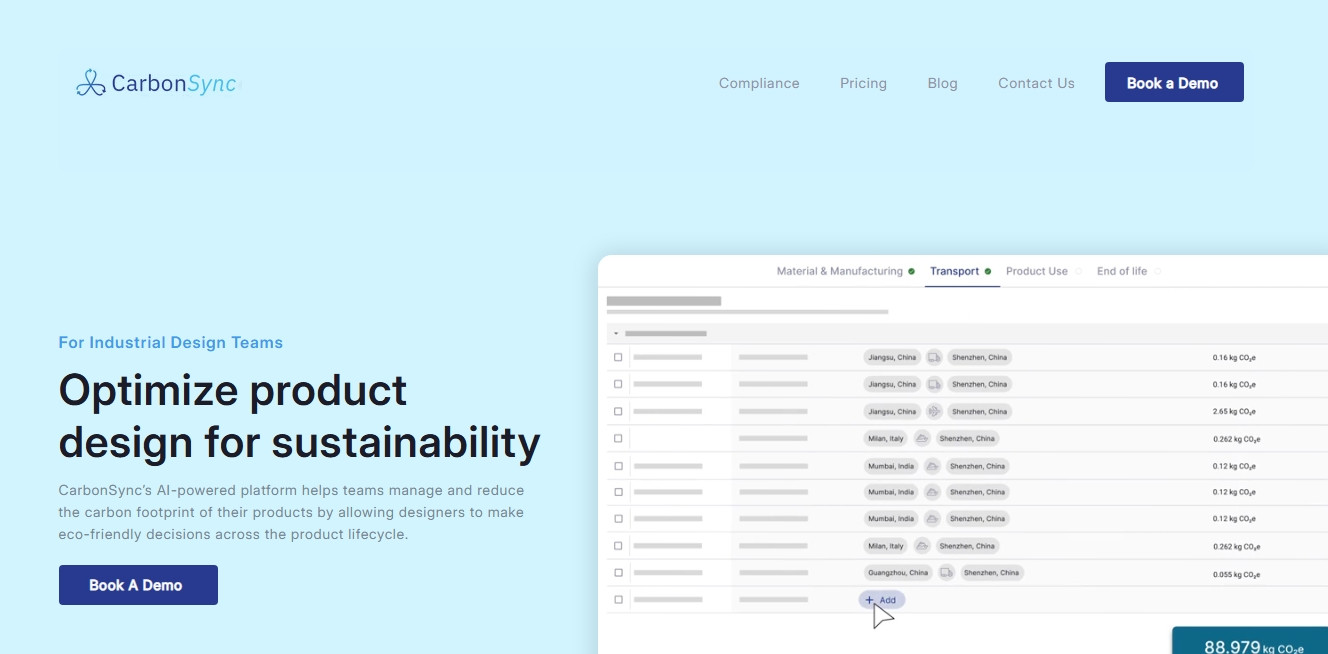
Real-Time Footprint Calculation: Instantly visualizes changes to a product’s total carbon emissions as designers swap materials or adjust designs, enabling iterative optimization.
Lifecycle Impact Visualization: Models and displays a product’s environmental impact across key stages, from manufacturing to end-of-life, providing a comprehensive sustainability view.
Seamless CAD Integration: Connects directly with existing computer-aided design (CAD) tools, fitting into established workflows without disrupting the creative process.
Compliance Preparedness: Helps teams design products that align with evolving environmental regulations from the outset, mitigating future compliance risk and potential penalties.
Design Comparison Dashboard: Allows designers to run side-by-side comparisons of different product versions to objectively select the most eco-friendly and efficient option.
Closing Insights
CarbonSync's development is driven by a clear industry need: to make sustainable design actionable for the engineers and designers who determine a product's fundamental environmental impact. The platform was created to overcome the traditional barriers of complex product lifecycle assessments (LCAs), which often treat sustainability as an afterthought. By building tools that integrate seamlessly into existing CAD workflows, CarbonSync aims to democratize sustainability expertise, empowering entire product teams to contribute to eco-design regardless of their specialized knowledge.
CarbonSync is particularly well-suited for manufacturers and design teams facing stringent product-level environmental regulations, especially those targeting the European Union and North American markets. Its forthcoming features for EU ESPR compliance make it highly relevant for companies producing consumer electronics, furniture, and medical devices. The platform's strength lies in upstream Scope 3 emissions reduction. It is most valuable for companies whose primary carbon footprint is embedded in the materials and manufacturing of the physical goods they design or produce. It is less suited for companies that only need high-level, spend-based corporate carbon accounting.
In summary, users should consider CarbonSync if their goal is to "design out" carbon at the source. It shifts sustainability from a reporting burden to a core design parameter, potentially cutting consulting costs and accelerating the development of compliant, market-ready sustainable products. For teams already using professional CAD software, its direct integration offers a practical path to embed emissions intelligence directly into the creative process.