

Available Carbon Accounting Features
Missing Carbon Accounting Features
Pricing
Starting Price
Options
Available Since
Deployment Options
Good Option For
- Small Business (11-50 people)
- Medium Business (51-250 people)
- Large Business (250+ people)
Deep dive
Core Features
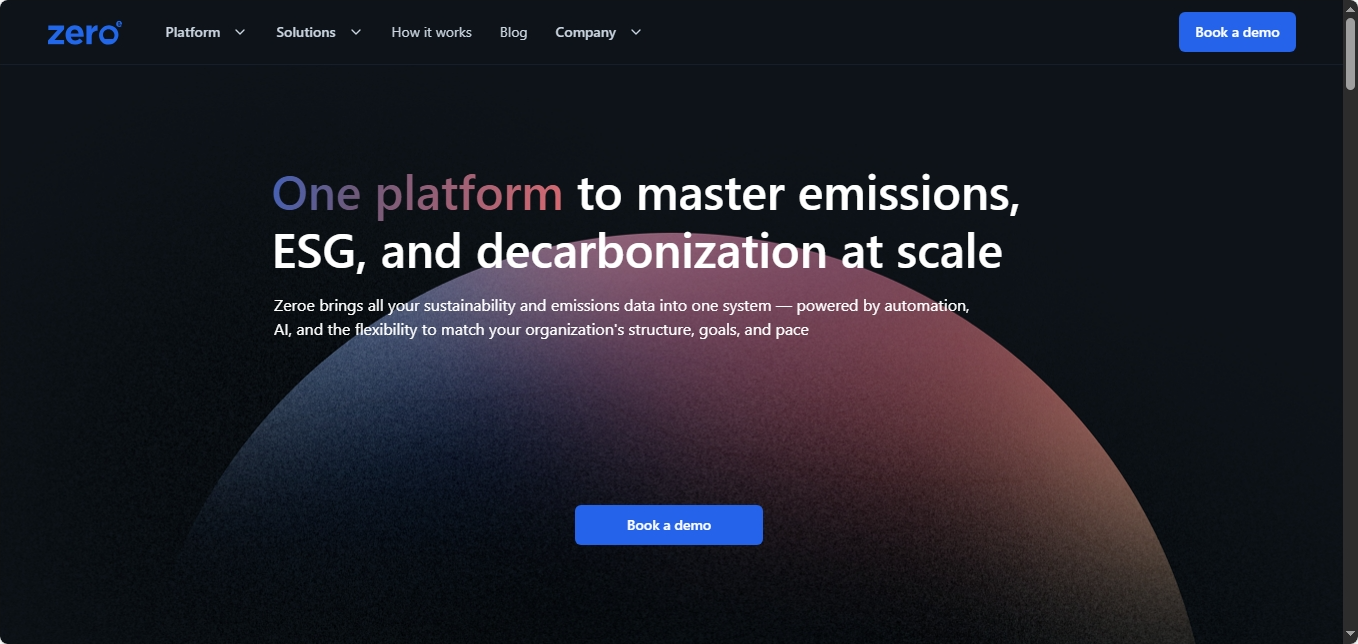
Zeroe takes a structured, model-driven approach that focuses first on organizing sustainability and emissions data around an organization’s existing entities, reporting frameworks and workflows. Its methodology combines automated data ingestion, AI classification, and configurable logic, enabling repeatable emissions accounting and ESG reporting across an enterprise.
Automated emissions accounting: Captures and classifies Scope 1, 2, and 3 data from uploads, APIs, and integrated systems with rules-based logic that ensures structured, traceable emissions results.
AI-assisted data processing (Zeroe Atlas): Transforms unstructured and messy data into emissions-ready formats, applying context-aware classification and automated factor matching.
Configurable organizational mapping: Maps data to business units, cost centers, and reporting hierarchies so emissions and ESG metrics align with internal structures and financial systems.
Audit-ready reporting: Generates standardized outputs aligned with major frameworks, maintaining traceability and version histories for assurance.
Task and workflow management: Built-in task assignment and traceability help teams collect, validate, and approve data across functions, supporting cross-department collaboration.
ESG metrics integration: Consolidates environmental, social, governance, and custom KPIs across departments, linking them to emissions data for unified reporting and analysis.
Closing Insights
Zeroe was founded to address the challenges sustainability professionals face when managing fragmented data, manual processes, and ambiguity in Scope 3 emissions, aiming to provide a “digital infrastructure” capable of matching the rigor and traceability of financial systems. Its team combines expertise in data systems, automation, AI and sustainability to build a platform aimed at enterprises requiring consistent, auditable emissions and ESG reporting. Zeroe is headquartered in Abu Dhabi and serves clients across sectors facing complex multi-jurisdictional reporting and compliance demands.
In 2024, Zeroe completed a seed funding round raising a total of $2.3 million, led by VOYAGERS ClimateTech Fund and other investors, supporting expansion of its platform and market reach. The platform’s structured data layer, AI-enabled ingestion, and alignment to multiple reporting standards aim to help organizations build reliable inventories quickly and reduce reliance on spreadsheets or disparate tools. Its workflow features support cross-functional collaboration, and its reporting outputs are designed for boards, regulators, and investors alike. Buyers typically engage through quote-based subscription discussions, with implementation support available via partners or professional services.