Revised EU Waste Framework Directive Enters into Force, Targeting Textile and Food-Waste Streams

Cut through the green tape
We don't push agendas. At Net Zero Compare, we cut through the hype and fear to deliver the straightforward facts you need for making informed decisions on green products and services. Whether motivated by compliance, customer demands, or a real passion for the environment, you’re welcome here. We provide reliable information. Why you seek it is not our concern.
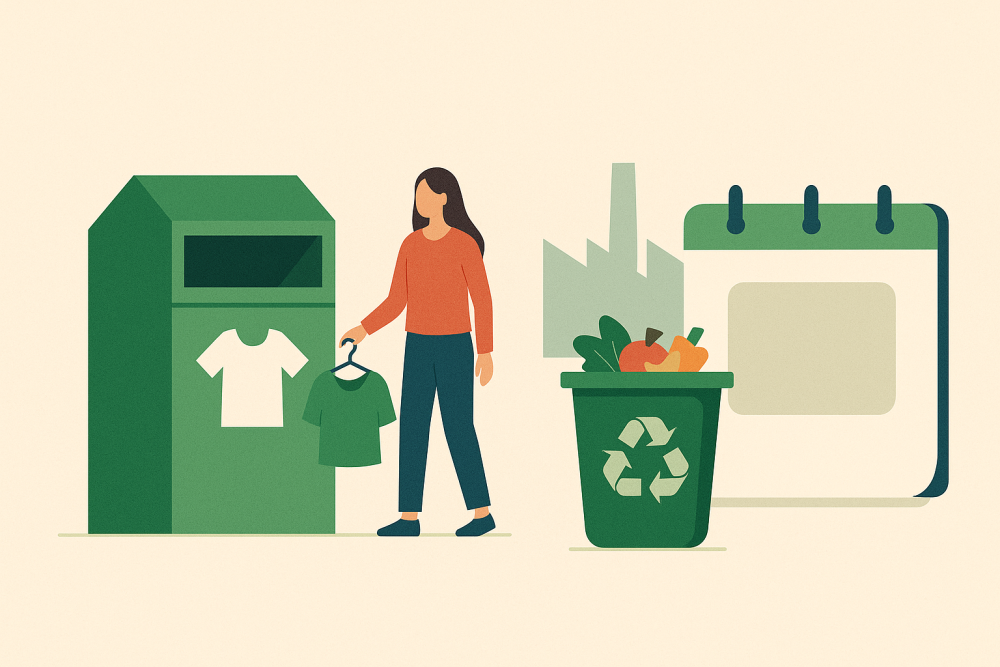
On 16 October 2025, the revised Waste Framework Directive officially entered into force across the European Union. The reform is a central element of the EU’s circular-economy and net-zero transition agenda, designed to reduce waste, conserve resources, and encourage sustainable production and consumption. The new framework focuses on two main pillars: binding food-waste reduction targets and harmonised extended producer responsibility (EPR) rules for the textile and footwear sectors.
Textile Waste: EPR Schemes and Circular-Design Incentives
The European textile and footwear industry employs over a million people and generates hundreds of billions of euros annually, but it also contributes significantly to environmental pressures. The revised Directive requires Member States to establish EPR schemes for textiles and footwear by April 2028, unless they already have systems in place.
Under these new rules, producers, whether based in the EU or exporting to the bloc, will be responsible for financing the collection, sorting, recycling, and reuse of textiles. This shifts the cost burden from municipalities to producers and encourages product design that considers end-of-life management.
EPR fees will follow an “eco-modulation” principle, meaning producers that place more sustainable and durable products on the market will pay lower fees. The Directive also clarifies what constitutes “used textiles” versus “waste textiles” and introduces obligations for sorting before exports, aiming to stop the mislabelling of waste shipments as reusable goods.
For businesses, the implications are wide-ranging. Textile and footwear brands will need to adapt their product-design processes, strengthen supply-chain transparency, and prepare for stricter reporting. Waste-management operators and recyclers will need to scale up capacity to meet new collection and sorting demands.
Food-Waste Reduction: First Binding EU Targets
For the first time, the EU now sets legally binding food-waste reduction targets for Member States to meet by the end of 2030. These include a 10 percent reduction in food waste generated during manufacturing and processing, and a 30 percent per-capita reduction in food waste from retail, restaurants, catering, and households, compared with the 2021–2023 average.
Member States must take steps to prevent food waste before it occurs, encourage redistribution of surplus food, and minimise the disposal of edible products. This will require coordination across supply chains and more accurate data collection. For retailers and hospitality sectors, food-waste audits and prevention strategies will likely become routine parts of compliance and sustainability planning.
Broader Implications for the Circular Economy
The revised Directive strengthens the EU’s long-term transition toward a circular economy, applying the “polluter pays” principle more systematically. By holding producers responsible for the life cycle of their products and rewarding sustainable design, the Directive aims to reduce resource dependency and greenhouse-gas emissions linked to production and waste management.
For industries, compliance may entail higher upfront costs, but it also encourages innovation in circular business models, such as repair services, reuse and rental platforms, textile-to-textile recycling technology, and advanced waste-data systems. Waste-management operators and technology providers stand to benefit from the growing demand for sorting, reuse, and recycling capacity.
Implementation Timeline and National Transposition
Although the Directive has entered into force, Member States have around 20 months to transpose its provisions into national law, placing deadlines in mid-2027. For textile EPR schemes, the deadline is set for April 2028.
Companies are encouraged to act early, reviewing their product portfolios and waste-management strategies to prepare for national legislation. The timeline leaves little margin for delay, and both governments and industry are expected to accelerate investments in infrastructure and guidance to ensure readiness.
Challenges and Stakeholder Perspectives
Environmental organisations have welcomed the Directive as a significant step forward, though many argue that the food-waste reduction targets are less ambitious than global sustainability goals. Industry associations in the textile sector have highlighted the need for harmonised implementation across Member States to prevent market fragmentation and ensure fair competition.
Despite these concerns, the revised Directive sends a strong signal that waste prevention and circularity are now central to EU economic policy. It reinforces the idea that sustainability responsibilities should be shared throughout the value chain, from producers and retailers to consumers and waste operators.
Practical Implications for Businesses
Textile and footwear brands must integrate circular design and end-of-life considerations into product planning and pricing.
Retailers and food-service companies need to measure and report food-waste levels and adopt prevention measures before the 2030 deadlines.
Waste-collection and recycling operators should prepare for a rapid scale-up in sorting and treatment infrastructure.
Sustainability and compliance teams must monitor national transposition processes and adapt strategies accordingly.
Investors and innovators can find new opportunities in recycling technologies, resource recovery, data analytics, and sustainable product design.
Conclusions
The revised Waste Framework Directive represents a major advance in EU environmental policy and the circular-economy transition. By introducing binding food-waste targets and extending producer responsibility to textiles, the EU is reinforcing its commitment to sustainable production, waste prevention, and resource efficiency. For industries, the new framework presents both regulatory challenges and opportunities for innovation that align with Europe’s broader net-zero goals.
Source: environment.ec.europa.eu

Mentioned in this article...
More related content

OMV Warns Rigid Recycling Rules May Slow Plastics Innovation

Wind and Solar Overtake Fossil Fuels in EU Power Generation

OpenAI Outlines Strategy to Control Rising Data Centre Energy Costs
