

Available Supply Chain Sustainability Features
Missing Supply Chain Sustainability Features
Pricing
Starting Price
Options
Available Since
Deployment Options
Good Option For
Deep dive
Core Features
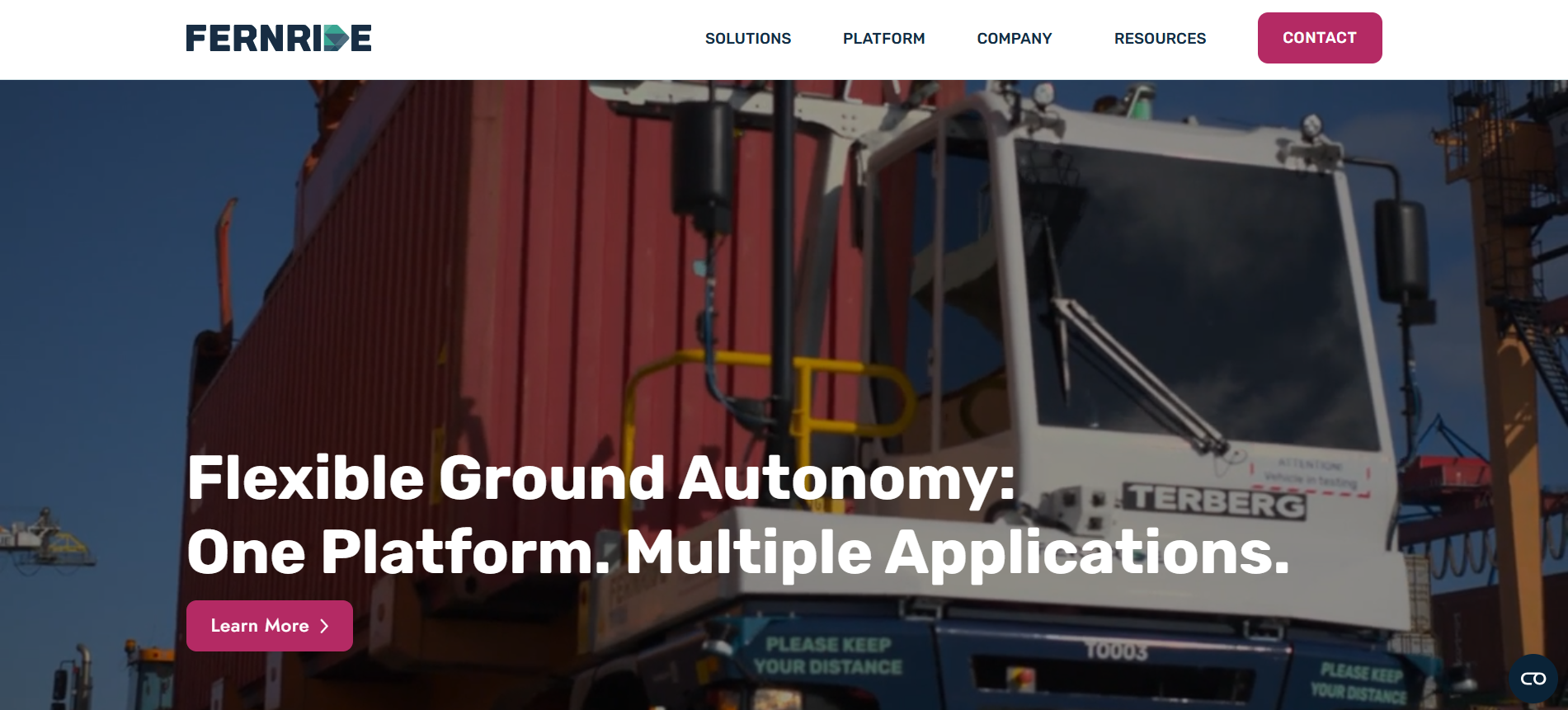
Fernride is a logistics automation and autonomous vehicle platform designed for yard, terminal, and industrial transport operations.
Its key innovation is the model of human-assisted autonomy, where electric autonomous trucks operate independently but can be remotely supervised and controlled by teleoperators when necessary.
Main capabilities:
Teleoperation and human-assisted driving: remote operators oversee autonomous vehicles and can take control in complex situations, ensuring safety and reliability.
Vehicle retrofit kits: modular hardware allows existing terminal or yard vehicles to be converted into autonomous units without full fleet replacement.
Integration with Terminal Operating Systems (TOS): connects with existing yard and port management software, receiving tasks and reporting status automatically.
Advanced sensing technology: combines 360° cameras, LiDAR, radar, and low-latency 4G/5G connectivity for safe navigation in mixed-traffic environments.
Scalable deployment: supports step-by-step rollout, from pilot projects to full operational deployment with minimal infrastructure disruption.
Sustainability benefits: reduces emissions and energy consumption by electrifying yard transport and optimizing fleet usage.
Plans & Pricing
Fernride does not publish public pricing or tiered plans.
The platform follows a custom, project-based pricing model, typically depending on:
Number of vehicles or units deployed,
Site infrastructure and connectivity requirements,
Integration complexity with existing systems,
Ongoing support, maintenance, and teleoperation services.
Companies generally begin with pilot or proof-of-concept projects before scaling to full deployment.
Real-world examples include collaborations with DB Schenker and HHLA TK Estonia, indicating that pricing is negotiated per project and scope.
Integrations
Fernride is built for deep interoperability within logistics ecosystems:
Terminal Operating Systems (TOS): integration for automated task dispatch and reporting.
Vehicle OEMs: partnerships with manufacturers such as KAMAG to retrofit electric trucks with Fernride’s autonomous kits.
Connectivity infrastructure: compatible with private, 4G, and 5G networks for ultra-low-latency teleoperation.
Fleet management and monitoring systems: telemetry and dashboards consolidate data for central visibility and control.
Certifications & Awards
Fernride earned TÜV SÜD certification under the European Machinery Directive (2006/42/EC), becoming one of the first autonomous tractor platforms in Europe to achieve this safety validation.
The company has also received industry recognitions, including the German Mobility Award 2020 and the de: hub Award, celebrating its innovation in teleoperation and sustainable logistics.
Expert Voices & Reviews
CEO Hendrik Kramer explained the company’s philosophy:
“We believe that a fully autonomous solution that is safe, reliable, and economically viable is still decades away. That’s why our human-assisted approach to autonomy is the realistic path to becoming the global leader in autonomous trucking.”
Sebastian Schuhmann, Head of Global Innovation Portfolio at DB Schenker, noted:
“The partnership with Fernride helps us understand the requirements for highly automated yard operations. The company is redefining the role of drivers, empowering them instead of replacing them.”
Customers & Case Studies
DB Schenker (Netherlands): pilot project deploying remotely operated yard trucks in live logistics operations.
HHLA TK Estonia: implementation of TÜV-certified autonomous terminal tractors in container operations.
KAMAG collaboration: joint development of electric “swap-body” autonomous trucks for yard logistics.
These projects highlight Fernride’s real-world applicability for large-scale industrial and logistics operations focused on safety, efficiency, and emission reduction.
Closing Insights
Fernride represents one of the most practical and commercially mature solutions in the autonomous logistics space. Rather than chasing full autonomy, a goal that remains technologically and economically distant for most industrial use cases, Fernride’s human-assisted autonomy model strikes a smart balance between innovation and operational realism.
Its approach enables logistics operators to adopt automation today without the risks typically associated with purely self-driving technology. By combining on-board AI with remote human supervision, Fernride provides a bridge between manual operations and a fully autonomous future. This makes the platform both deployable in the short term and scalable in the long term.
From a business perspective, the strongest advantages are its retrofit capability and system integration flexibility. Instead of forcing companies to replace fleets or rebuild IT infrastructure, Fernride works with existing assets and digital systems, drastically lowering the barrier to entry. This approach also accelerates ROI by converting conventional assets into connected, semi-autonomous ones.
The TÜV SÜD certification adds an important layer of trust, confirming compliance with rigorous European safety standards. Combined with proven deployments at DB Schenker and HHLA TK Estonia, it demonstrates that Fernride is not just a prototype but a validated, field-tested industrial solution.
On the other hand, Fernride’s limitations are consistent with its niche: deployment still requires substantial infrastructure preparation, network connectivity, and site adaptation. The pricing transparency is low, understandable for project-based models, but potentially a barrier for smaller operators exploring automation. Its current scope is confined to private environments such as terminals, yards, and closed industrial campuses, not yet public roads or mixed-traffic highways.
Overall, Fernride stands out as a best-in-class choice for large logistics and industrial players looking to boost operational efficiency, worker safety, and sustainability. For companies operating in ports, warehouses, or manufacturing hubs with repetitive transport cycles, Fernride’s technology offers tangible and immediate value. For smaller fleets or less standardized sites, the value proposition will depend on future reductions in cost and integration complexity.
In our expert view, Fernride delivers a realistic, scalable, and certified pathway to autonomous logistics, bridging the gap between today’s human-driven systems and tomorrow’s fully automated supply chains.