

Available Carbon Accounting Features
Missing Carbon Accounting Features
Pricing
Starting Price
Options
Available Since
Deployment Options
Good Option For
- Small Business (11-50 people)
- Medium Business (51-250 people)
- Large Business (250+ people)
Deep dive
Core Features
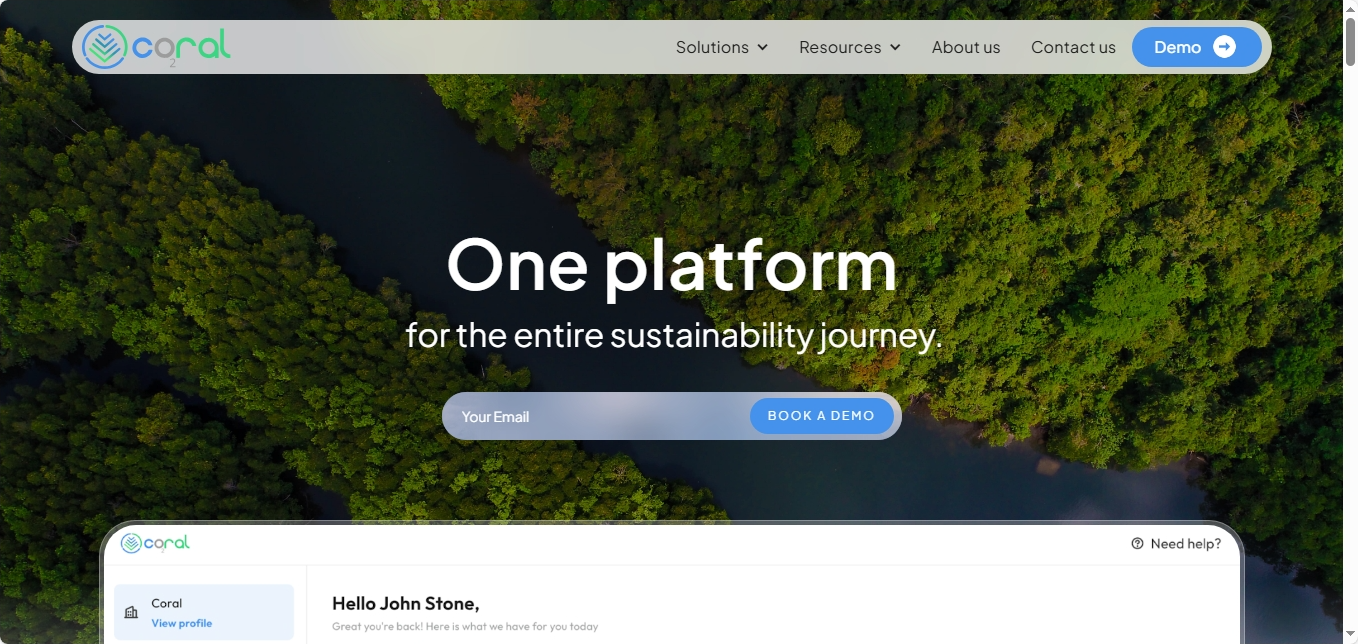
Coral’s approach treats emissions measurement as a data-integration and assurance workflow: bring operational activity data into a single inventory, apply methods aligned to the GHG Protocol and ISO 14064-1 across scopes, and keep outputs ready for disclosure and assurance without rebuilding the dataset each reporting cycle. Some of its main features are:
Data centralization via uploads and APIs — Upload CSVs/PDFs or sync via APIs to ERP, accounting, and logistics tools; documents can be uploaded in multiple languages with automated data extraction.
Activity-based Scope 1–3 calculations — Converts activity data to greenhouse-gas estimates using region- and activity-specific emission factors, with methods aligned to the GHG Protocol and ISO 14064-1.
Hotspot discovery across the value chain — Supports drill-down analysis by suppliers, sites, materials, and lanes, including end-to-end Scope 3 tracing (e.g., purchased goods, transport, waste).
Compliance-oriented reporting outputs — Generates auditor- and board-ready reporting outputs mapped to frameworks such as CSRD, GRI and CBAM, among others.
Targets, reminders, and ranked initiatives — Tracks targets, automates reminders, and surfaces AI-ranked initiatives linked to the underlying finance/procurement/ops data feeds.
Offsets with traceability controls — Provides access to certified offset projects (e.g., Gold Standard, Verra/VCS, ICR), downloadable certificates, and blockchain-based proof of purchase/impact; also supports internal carbon pricing and e-commerce/event offset workflows.
Closing Insights
Coral was founded in 2022 by Juergen Hoebarth and Daniele Sileri as a UAE-based climate-tech company focused on carbon emission management and offsetting. The platform is presented as an AI-driven system that automates carbon data collection, footprint evaluation, reporting, and offsetting in one workflow, and it also markets blockchain-based proof for offset purchases. Coral recently announced the closure of a $3 million seed funding round.
Customer materials frame Coral around time-bound disclosures and verification. An OKX case study describes producing an audit-ready ESG report in under four weeks, including blockchain transactions and staking. Nissan Formula E has also used the platform to centralize emissions tracking and meet FIA sustainability requirements.
With seed funding in place, Coral is positioned to expand product development and integrations, supporting broader adoption among organisations seeking unified carbon accounting, streamlined disclosures, and verifiable offset solutions across their operations.