

Available Life Cycle Assessment (LCA) Features
Missing Life Cycle Assessment (LCA) Features
Pricing
Starting Price
Options
Available Since
Deployment Options
Good Option For
- Small Business (11-50 people)
- Medium Business (51-250 people)
- Large Business (250+ people)
Deep dive
Core Features
Climate Earth’s pairs detailed, plant-level production and mix-design data with concrete-specific LCA engines and then delivers EPDs and analytics through a cloud platform built with microservices. Rather than treating EPDs as occasional studies, its CarbonCLARITY architecture turns them into routinely generated, digital product data that can be reused across bids, specifications and portfolio analysis. Its more specific capabilities include:
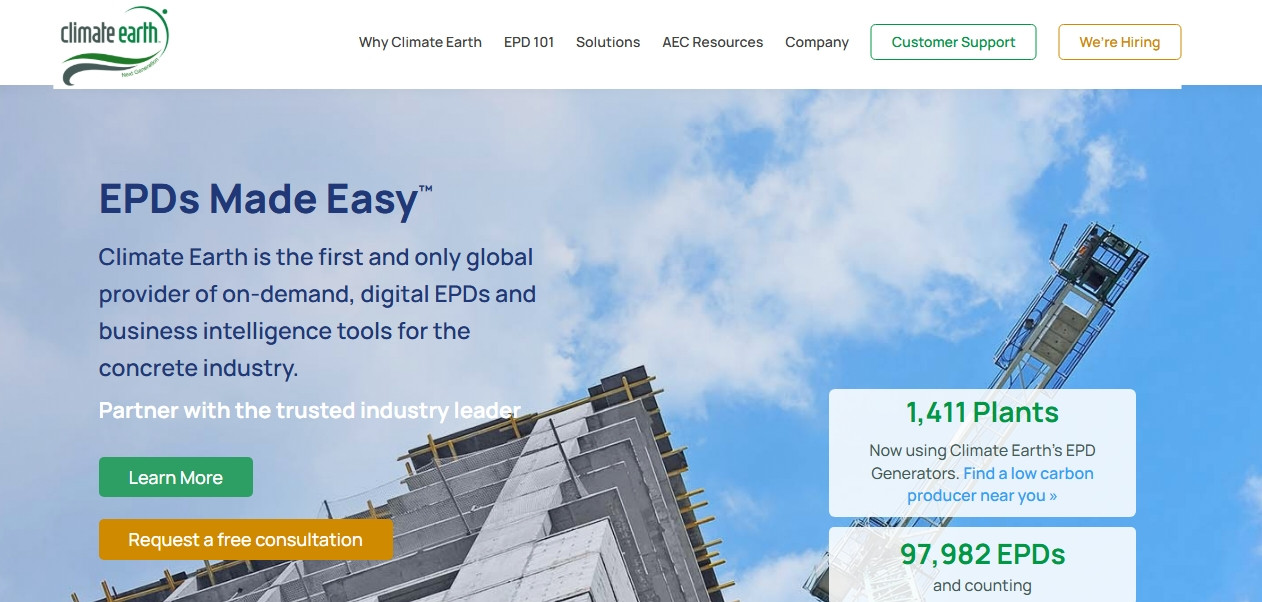
On-demand EPD generators - Climate Earth offers EPD generators for ready-mix, masonry, cement and other segments that guide data collection, then produce fully verified, plant-specific EPDs in seconds; the company reports more than 50,000 third-party-verified EPDs and coverage of over 700 plants worldwide.
Concrete-specific LCA workflows - For producers, the software provides structured workflows covering supplier, material, transport and operational data, quantifies impacts of all process inputs, prepares LCAs for third-party verification and outputs branded, easy-to-read Type III EPDs.
CarbonCLARITY system architecture - CarbonCLARITY is described as the first cloud-based system built specifically to help the concrete industry compete in low-carbon construction, combining automated EPD creation, sales tools and analytic applications on a scalable microservices architecture.
Mix optimisation and code analytics - EPD Advantage Pro adds Tarantula Curve Mix Optimization for digital trial mix design and ACI 323 low-carbon concrete code analytics, enabling users to test mixes against benchmarks such as NRMCA industry averages and California or New York State GWP thresholds.
Portfolio-level intelligence and project GWP - As an EPD information-management system, Advantage Pro lets producers evaluate entire EPD portfolios, compare mix designs, and generate graphics showing project-level weighted GWP and alignment with agency or client thresholds, supporting low-carbon bids and specifications.
Integrations and ecosystem link - Climate Earth’s generators integrate with quality-control systems such as Stonemont Solutions and Command QC, allowing QC staff to trigger EPDs from their consoles, while Digital EPDs flow directly into the EC3 database through a partnership with the Carbon Leadership Forum and C-Change Labs.
Closing Insights
Climate Earth was founded in 2008 by Chris Erickson, who previously spent more than 25 years in Silicon Valley as a Fortune 500 vice-president and CEO of four software start-ups. He established the platform to automate life-cycle assessment, moving it from a manual, study-driven discipline to a business-friendly, data-driven process for the concrete industry. Over 17 years, that focus has evolved into a network of cloud-based EPD generators covering all major concrete sectors and operating in over 1,000 plants across North America, Europe and Asia. Producers such as Holcim and CarbiCrete have publicised collaborations with Climate Earth to certify low-carbon concrete portfolios and cement-free products, respectively, while industry coverage notes that the company holds one of the largest ready-mix EPD data repositories.
With demand for concrete EPDs rising as Buy Clean and related procurement policies spread across US federal and state programmes, EPDs are becoming a routine requirement rather than an exception. Federal and state initiatives now commonly require EPDs for materials such as concrete, steel, asphalt and glass, and have already triggered tens of thousands of new declarations. Most public projects, including LEED and Buy Clean jobs, now require concrete EPDs for bidding and compliance, and its generators are designed to create unlimited, verified EPDs quickly from a maintained data model. In that context, platforms like Climate Earth are positioned not only to support one-off compliance for individual bids, but to help producers treat EPDs as continually refreshed, digital product data that can be updated as mixes evolve and reused across multiple projects.