

Available Climate Risk Management Features
Missing Climate Risk Management Features
Pricing
Starting Price
Options
Available Since
Deployment Options
Good Option For
- Small Business (11-50 people)
- Medium Business (51-250 people)
- Large Business (250+ people)
Deep dive
Core Features
ClimaSens frames climate change as a physical risk problem that can be quantified with data rather than handled as an abstract scenario. Its methodology blends historical climate records, real-time weather feeds and future climate projections with satellite imagery and socio-economic indicators, using AI and geospatial analytics to generate location-based risk assessments at multiple scales and time horizons. Within this framework, the platform offers several practical capabilities:
Multi-hazard risk analytics – Assesses exposure to hazards such as extreme heat, floods and storms by combining climate and weather models with spatial data, supporting cross-hazard comparisons for specific regions and assets.
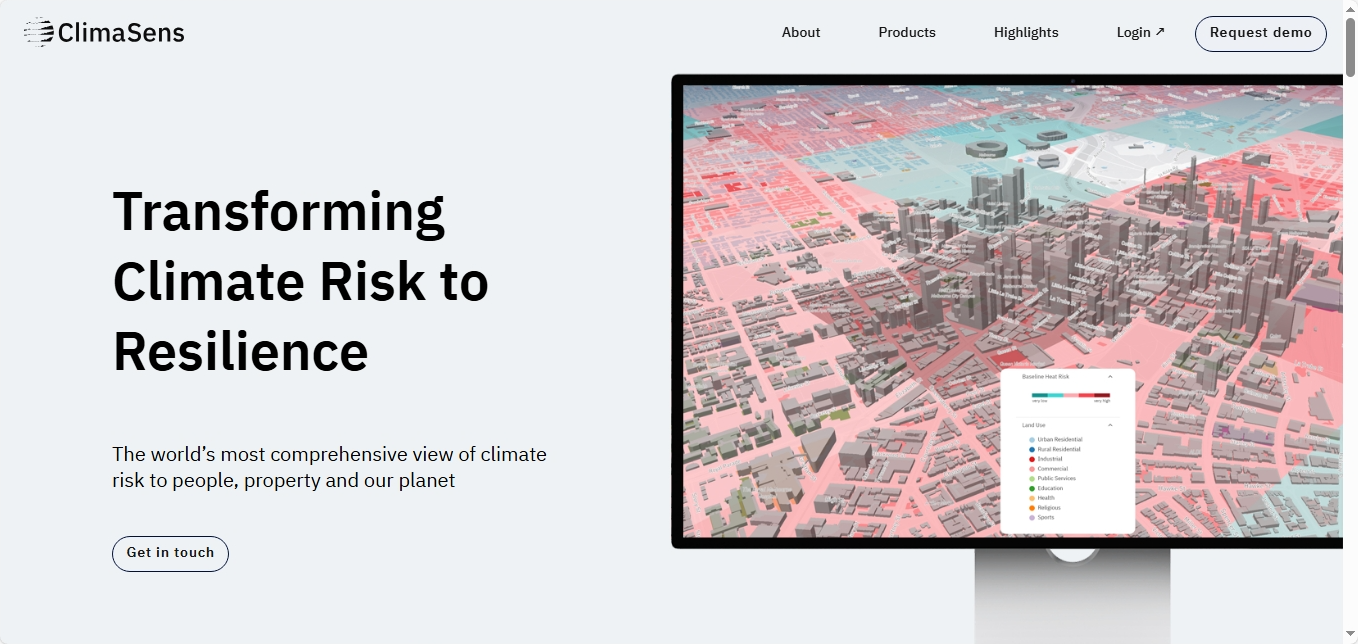
Hyper-local asset assessments – Produces risk metrics at asset and property level worldwide, with products like HeatSens offering heat-risk analysis from national coverage down to grids of about one kilometre.
Social vulnerability and health overlays – Links climate hazards with demographic and health data so users can see where vulnerable populations face the greatest risks, as demonstrated in pilots with the Australian Red Cross.
Urban resilience planning tools – Provides maps and indicators that city governments use to identify heat hotspots, prioritise cooling interventions and design resilience strategies, for example in City of Melbourne and City of Yarra projects.
SaaS platform and enterprise APIs – Delivers climate risk intelligence through a web-based platform and APIs, allowing financial institutions, asset managers and reinsurers to integrate data into their own analytics and reporting systems.
Support for reporting and strategy – Supplies quantified hazard and vulnerability metrics that feed into climate-risk assessments, regulatory disclosures and adaptation strategies, including joint studies on extreme heat risk with partners such as KPMG.
Closing Insights
ClimaSens was founded in 2017 in Melbourne by Joseph Glesta, Shaun Burriss, Jaskirat Randhawa and Timon McPhearson, later joined by co-founder and CTO Daniel Sauter. Glesta’s background in sustainability, climate policy and community resilience, together with McPhearson’s urban systems research and Sauter’s work on data visualisation, shapes a focus on translating climate science into tools that city officials, humanitarian organisations and financial actors can apply in practice.
Rather than carbon accounting, the platform concentrates on physical climate hazards, social vulnerability and asset exposure. This emphasis is visible in collaborations on HeatSens with the City of Melbourne and the Australian Red Cross, where geospatial analytics identify heat-vulnerable neighbourhoods for targeted support, as well as in joint risk assessments on extreme heat across Australia with KPMG. ClimaSens’s client list includes the City of Melbourne, City of Yarra, Australian Red Cross and KPMG, and the company participates in global initiatives such as the ClimateIQ project, backed by a Google.org Impact Challenge grant in partnership with the Urban Systems Lab.
Prospective users typically engage via the SaaS platform or through APIs for portfolio-scale analysis, with projects often delivered alongside partners like KPMG and the Urban Systems Lab. This makes ClimaSens a candidate for organisations that need detailed physical climate risk data and decision support to complement, rather than replace, existing sustainability and reporting tools.