

Available Life Cycle Assessment (LCA) Features
Missing Life Cycle Assessment (LCA) Features
Pricing
Starting Price
Options
- Free
- Annual Subscription
Available Since
Deployment Options
Good Option For
- Small Business (11-50 people)
- Medium Business (51-250 people)
- Large Business (250+ people)
Deep dive
Core Features
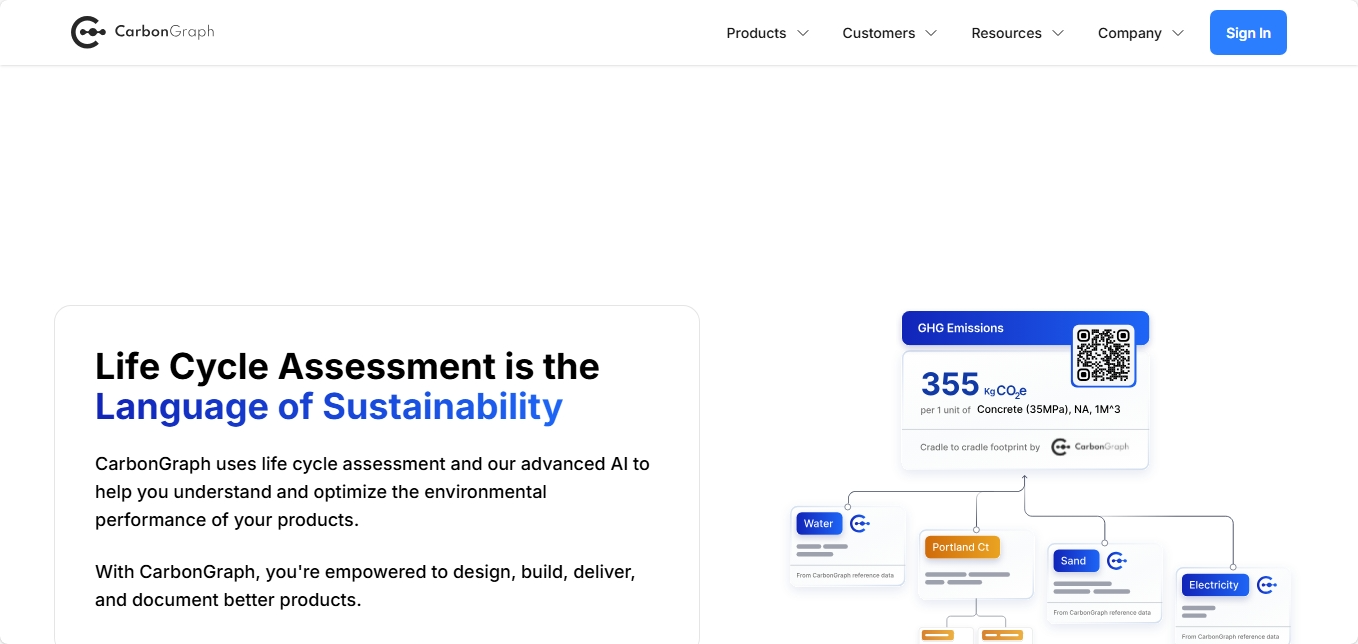
CarbonGraph applies process-based LCA using a graph representation of supply chains. Users can build models from text descriptions or bills of materials, bring in primary data, link curated LCI datasets, and then move from screening to verified studies without switching tools. Within this methodology, some of the platform’s main capabilities are:
Tiered LCA workflow - EcoScan offers rapid screening and hotspot identification, while higher tiers support comprehensive “Operational” and “Verified” assessments for internal decisions, EPDs and regulatory reporting.
Graph-based model editor - Assessments are built in Graph View, connecting inventories as nodes and flows, supporting detailed LCIs, versioning, and iterative impact assessment for complex supply chains.
Primary data plus curated datasets - Models combine organisation-specific data with version-controlled datasets from ecoinvent, NREL USLCI and IDEMAT, all adapted for seamless use and kept in sync.
Standards-aligned reporting & verification - The “Verified” tier and Trinity Consultants collaboration support high-accuracy models for EPDs, PCFs and other disclosures with third-party verification and enterprise-wide LCAs.
AI tools for screening and interpretation - EcoScan uses AI to build screening-level cradle-to-gate LCAs from short descriptions, while an in-platform AI Agent explains models, identifies hotspots and drafts standard-aligned summaries.
Education and capacity-building resources- A knowledge centre offers LCA methodology guides, platform tutorials and dataset documentation, supporting both beginners and expert practitioners; educators use CarbonGraph for teaching systems thinking.
Closing Insights
CarbonGraph grew from its founders’ experience in engineering and consulting, where they saw manufacturers struggle to connect environmental performance with business decisions. Co-founder and head of product Luke Boivin, a chemical engineer and consultant, describes traditional impact assessment as slow, complex and hard to scale; he helped design the platform so decision-makers can treat LCA as an operational tool rather than an occasional study. Co-founder Sam Anderson, an engineer who consulted to global mining companies, emphasised that executives lacked clear mechanisms to communicate the value of sustainable supply chains to stakeholders, a gap CarbonGraph seeks to close.
This background helps explain the emphasis on graph-based models, AI-assisted workflows and reusable datasets. CarbonGraph’s partnership with Trinity Consultants positions the software inside a broader advisory offering for enterprise-wide LCAs and its output such as EPDs and PCFs. Case studies with Busch Systems, Upright Oats and others show the platform in use across packaging, food and education, supporting both design choices and customer communication.
For organisations exploring product-level sustainability, CarbonGraph offers a free EcoScan tier and paid professional licences that add advanced modelling, premium datasets, the AI Agent and other support.