

Available Climate Risk Management Features
Missing Climate Risk Management Features
Pricing
Starting Price
Options
Available Since
Deployment Options
Good Option For
- Medium Business (51-250 people)
- Large Business (250+ people)
Deep dive
Core Features
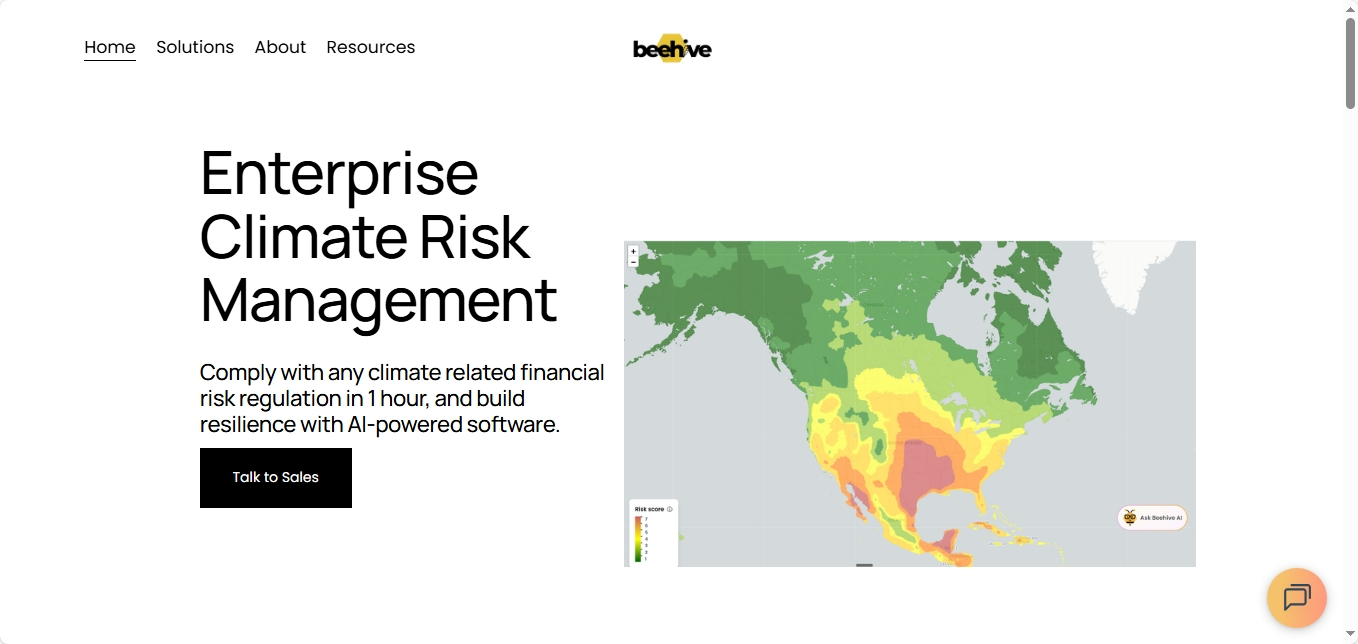
Using AI-powered insights, the Beehive platform aims to help businesses reduce the time spent on compliance reporting from months to as little as an hour. Its key features include:
Audit-ready physical risk on assets — Upload an address/zip code for offices, data centers, suppliers or factories and get a risk breakdown designed for board/investor use, with audit trails for underlying data points.
Scenario-based hazard modeling — Physical risk is assessed across multiple hazards and across scenarios/time horizons described in Beehive’s model documentation.
Transition risk tracking — Track large volumes of climate-relevant laws and bills and quantify revenue at risk, aimed at reducing spreadsheet-based monitoring.
Governance workflows — Provides governance setup guidance and supports recurring risk check-ins, with materials (e.g., decks) and records intended to flow into IFRS S2 disclosures.
IFRS S2/TCFD report drafting — Uses AI trained on IFRS S2/TCFD rules plus your uploads/public info to draft disclosures; Beehive also states its team reviews reports with customers.
Peer benchmarking and report library — Lets teams read peer climate-risk reports and compare answers, supporting faster legal/board review and gap checks.
Closing Insights
Beehive Climate was built by CEO Adriel Lubarsky and CTO Andrew Phavichitr to bring climate risk into enterprise risk management without months of consultant work. Lubarsky is a serial founder while Phavichitr started as a developer at Tata Consulting Services and Accenture before becoming lead developer or CTO at several startups. Beehive’s differentiator is transparency: it publishes model documentation stating that physical-risk assessments rely on government, academic and open-source datasets and assess hazards including wildfire, flood, cyclone, drought and heat.
Beehive is best suited where climate-risk disclosure needs to stand up to legal and investor scrutiny, such as California SB 261 in the U.S. and CSRD-driven programs in Europe, using IFRS S2/TCFD structures. It also lets users benchmark disclosures against peer reports. For teams short on specialist capacity, Beehive’s mix of AI drafting plus staff review can speed reporting while keeping a clear audit trail.